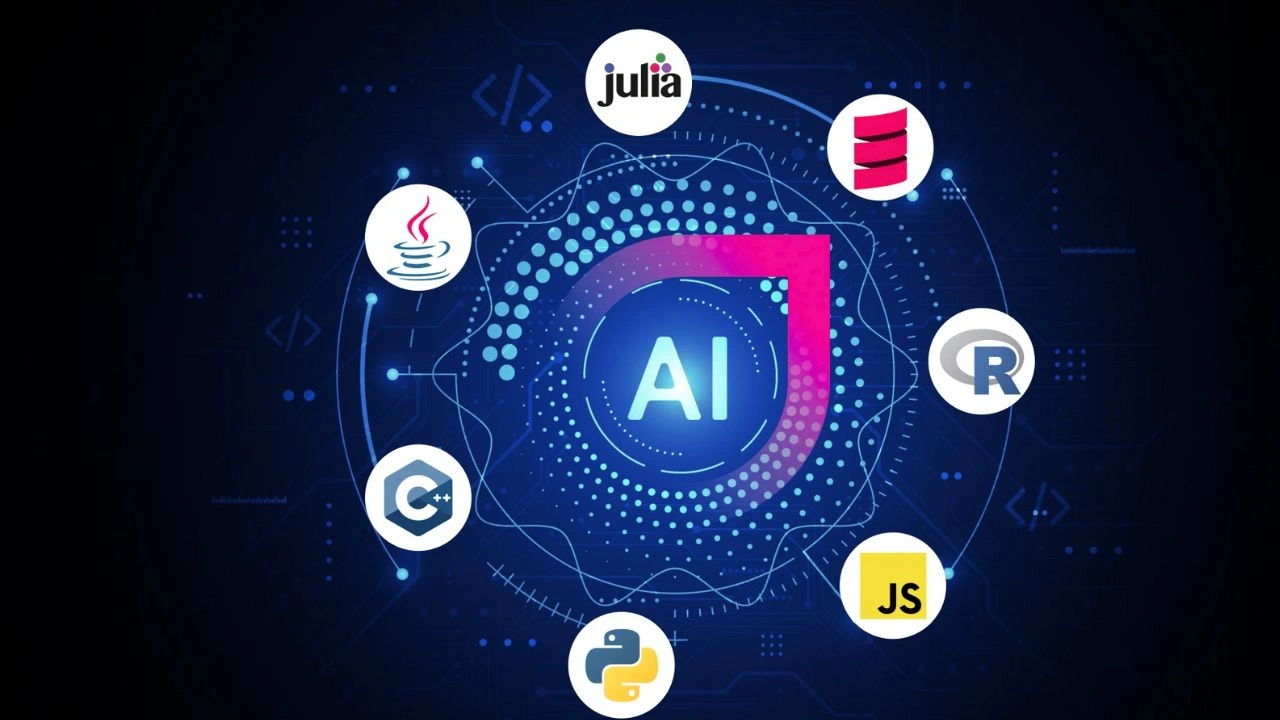
Artificial Intelligence Programming Languages: Artificial intelligence (AI) has become one of the most influential technological forces of the 21st century. From virtual assistants and recommendation systems to autonomous vehicles and advanced medical diagnostics, AI is reshaping industries across the globe. Behind every intelligent system lies code—and at the heart of that code are programming languages specifically suited to AI development.
Choosing the right programming language for artificial intelligence is not just a technical decision; it shapes how efficiently models are built, how easily systems scale, and how effectively ideas move from theory to real-world application. This article explores the major programming languages used in AI, why they are important, how they differ, and where each excels.
Why Programming Languages Matter in Artificial Intelligence
Artificial intelligence systems rely on complex algorithms, massive datasets, and continuous learning processes. Programming languages act as the bridge between human ideas and machine execution. A well-suited language can accelerate development, simplify experimentation, and enable seamless integration with hardware and software ecosystems.
AI development involves multiple stages, including data preprocessing, model training, deployment, and optimization. No single language dominates every stage, which is why AI engineers often use multiple programming languages within a single project.
Understanding which languages are used—and why—helps developers, researchers, and organizations make informed decisions when entering the AI field.
Read Also: Jasper AI Review 2025: Features, Pricing, Pros & Cons – Is Jasper Worth It?
Python: The Dominant Language of AI
Python is widely regarded as the most popular programming language for artificial intelligence. Its dominance stems from simplicity, versatility, and an unmatched ecosystem of AI-focused libraries.
Python’s syntax is clear and readable, allowing developers to focus on logic rather than complex syntax rules. This makes it ideal for experimentation, prototyping, and rapid development.
Python supports powerful libraries such as TensorFlow, PyTorch, Keras, Scikit-learn, NumPy, and Pandas. These frameworks provide pre-built tools for machine learning, deep learning, data analysis, and neural network construction.
Another major advantage of Python is its strong community support. Developers can access vast documentation, tutorials, and open-source projects, accelerating learning and innovation.
Python is commonly used in:
- Machine learning and deep learning
- Data science and analytics
- Natural language processing
- Computer vision
- Reinforcement learning
Despite being slower than some compiled languages, Python compensates with flexibility and ease of integration, making it the backbone of modern AI development.
R: Statistical Computing and Data Analysis
R is a programming language designed specifically for statistical computing and data analysis. While it is not as general-purpose as Python, it plays an important role in AI, particularly in research-heavy and data-driven environments.
R excels in data visualization, statistical modeling, and exploratory data analysis. It provides powerful tools for understanding datasets before they are used to train AI models.
Researchers and academics often use R for:
- Statistical machine learning
- Predictive modeling
- Data visualization
- Bioinformatics and healthcare analytics
R includes packages for machine learning and neural networks, although its ecosystem is smaller compared to Python. Its strength lies in deep statistical insight rather than large-scale AI deployment.
Java: Scalability and Enterprise AI
Java is a long-standing programming language known for stability, scalability, and platform independence. In artificial intelligence, Java is often used for building large-scale, production-level AI systems.
Java’s performance and strong memory management make it suitable for enterprise environments where reliability is critical. It integrates well with existing systems, especially in organizations already using Java-based infrastructure.
AI developers use Java for:
- Large-scale machine learning systems
- Natural language processing
- Search algorithms
- Distributed computing
Frameworks like Deeplearning4j support deep learning in Java, while Apache Spark’s MLlib enables distributed machine learning.
Java may not be as flexible as Python for experimentation, but it excels in robust, long-term AI solutions.
C++: High Performance and Real-Time AI
C++ is a powerful, low-level programming language widely used in AI applications where performance is critical. It provides fine-grained control over memory and system resources, making it ideal for time-sensitive tasks.
AI systems requiring real-time processing—such as robotics, game AI, autonomous vehicles, and embedded systems—often rely on C++.
C++ is commonly used in:
- Computer vision
- Robotics and automation
- Game artificial intelligence
- High-frequency trading AI
- Embedded AI systems
Many popular AI libraries, including parts of TensorFlow and OpenCV, are written in C++ for performance reasons. While C++ has a steeper learning curve, its efficiency makes it indispensable in high-performance AI applications.
Julia: High-Speed Scientific Computing
Julia is a relatively new programming language designed for numerical and scientific computing. It combines the ease of high-level languages with the speed of low-level languages.
Julia is gaining attention in AI research due to its ability to handle complex mathematical operations efficiently. It is particularly useful in machine learning research, optimization, and scientific simulations.
Key strengths of Julia include:
- High performance comparable to C++
- Simple syntax similar to Python
- Strong support for linear algebra
Although its ecosystem is still growing, Julia represents a promising option for next-generation AI research and development.
Lisp: The Historical Foundation of AI
Lisp holds a special place in the history of artificial intelligence. It was one of the first programming languages designed for symbolic reasoning and AI research.
Lisp’s flexible syntax and support for recursion made it ideal for early AI systems focused on logic, problem-solving, and symbolic manipulation.
While Lisp is less common in modern AI development, it is still used in:
- AI research
- Knowledge representation
- Symbolic reasoning systems
Lisp’s influence can still be seen in modern AI concepts, even though newer languages have largely replaced it in commercial applications.
Prolog: Logic-Based AI Programming
Prolog is a logic programming language designed for reasoning and rule-based systems. Unlike procedural languages, Prolog focuses on relationships and logical rules.
Prolog is well-suited for applications that involve inference, pattern matching, and decision-making based on logic.
Typical use cases include:
- Expert systems
- Knowledge-based systems
- Natural language processing research
While Prolog is not widely used in mainstream AI today, it remains valuable for specialized reasoning tasks and academic exploration.
JavaScript: AI in Web and Frontend Applications
JavaScript is not traditionally associated with AI, but it plays an increasingly important role in deploying AI models on the web.
With libraries like TensorFlow.js, developers can run machine learning models directly in web browsers. This enables interactive AI applications without requiring server-side computation.
JavaScript is commonly used for:
- Web-based AI applications
- Interactive visualizations
- Client-side machine learning
As AI becomes more accessible through web platforms, JavaScript continues to grow in importance.
MATLAB: Engineering and Research AI
MATLAB is widely used in engineering and scientific research. Its strength lies in matrix operations, simulations, and algorithm development.
AI researchers use MATLAB for:
- Image processing
- Signal processing
- Control systems
- Academic research
While MATLAB is not ideal for large-scale production AI, it remains valuable in prototyping and experimental research environments.
Scala: Big Data and AI Integration
Scala is often used in AI systems that rely heavily on big data processing. It integrates seamlessly with Apache Spark, making it suitable for large-scale machine learning workflows.
Scala combines object-oriented and functional programming, offering flexibility and performance.
Common applications include:
- Distributed machine learning
- Data-intensive AI systems
- Real-time analytics
Scala is especially popular in environments where AI and big data converge.
Choosing the Right Language for AI Development
There is no single “best” programming language for artificial intelligence. The right choice depends on the project’s goals, scale, and performance requirements.
- Python is ideal for beginners, research, and rapid development
- Java excels in enterprise-level systems
- C++ is best for real-time and performance-critical AI
- R supports statistical analysis and research
- JavaScript enables web-based AI deployment
Many AI systems use multiple languages together, combining Python for modelling, C++ for performance, and JavaScript for user interfaces.
Read Also: ChatGPT Review 2025: Features, Pricing, Pros & Cons – Is It Worth Using?
The Future of Programming Languages in AI
As AI evolves, programming languages will continue to adapt. New languages and frameworks will emerge to support explainable AI, ethical AI, and autonomous systems.
Automation tools and AI-assisted coding may reduce the importance of syntax, shifting focus toward problem-solving and system design. However, understanding programming languages will remain essential for building reliable and responsible AI.
Conclusion
Artificial intelligence is powered by a diverse ecosystem of programming languages, each contributing unique strengths. Python leads the way in flexibility and accessibility, while languages like Java, C++, R, and Julia support specialized needs across performance, scalability, and research.
Rather than replacing one another, these languages coexist—forming the technical foundation of intelligent systems that shape the modern world. Understanding their roles empowers developers and organizations to build smarter, more efficient, and more impactful AI solutions.