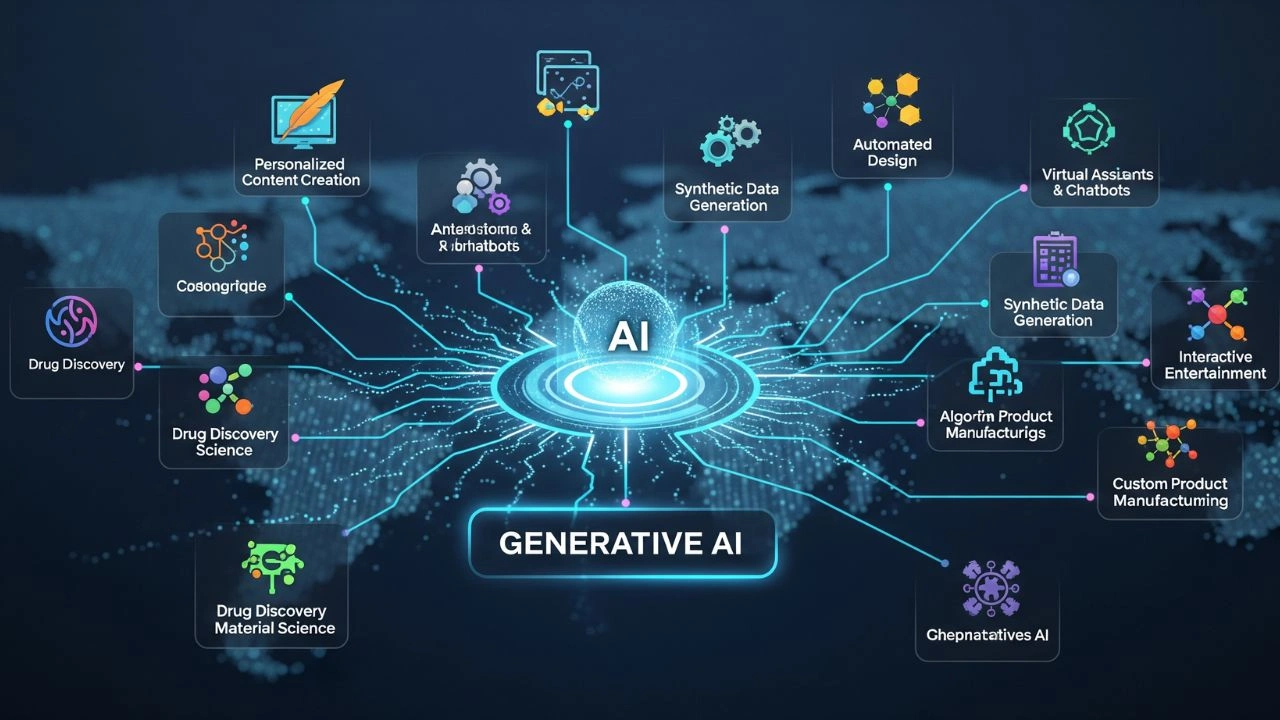
generative ai use cases creating new business models: Generative AI is no longer just a productivity booster or a creative assistant. In 2025, it has become a business model engine—a force that is reshaping how companies create value, deliver services, price products, and generate revenue. Instead of simply making existing workflows faster, generative AI is enabling entirely new ways of doing business that were not economically or technically possible before.
From AI-powered agents that deliver outcomes instead of software features, to creator marketplaces built around prompts and workflows, to usage-based “credit economies,” generative AI is changing the rules of commerce. Businesses that understand this shift are not just adopting AI—they are building around it.
This article explores the most important generative AI use cases that are actively creating new business models, explains how these models work, why they are growing fast, and how entrepreneurs, creators, startups, and enterprises can participate in this transformation.
Why Generative AI Creates New Business Models (Not Just Better Tools)
Traditional software businesses were built around predictable pricing models: licenses, subscriptions, seats, and professional services. Generative AI introduces something fundamentally different—variable intelligence at scale.
Every AI-generated output has a cost (compute, data, inference), but it also has measurable value. This makes it possible to price products in new ways:
- per generation
- per task
- per outcome
- per workflow
- per minute of intelligence
More importantly, generative AI can now perform work, not just assist humans. This shift—from tool to worker—creates space for business models where customers pay for results instead of access.
In simple terms:
- Software sells features
- Generative AI sells outcomes
That difference is what unlocks new economic structures.
1. Vertical AI Copilots: Intelligence Built for One Job
What this use case is about
AI copilots are assistants embedded into workflows. But the real business opportunity emerges when copilots are vertical-specific—designed for one role, industry, or task instead of everyone.
Examples include:
- AI SEO copilots for bloggers and agencies
- AI legal drafting copilots for contract review
- AI HR copilots for recruitment and onboarding
- AI finance copilots for forecasting and reporting
These systems understand industry language, regulations, templates, and workflows. They don’t just “chat”—they work inside the job.
Read Also: AI Video Tools That Turn Blog Posts into Videos 2026 Guide
Why this creates a new business model
Generic AI tools compete on brand and model quality. Vertical copilots compete on domain expertise and outcomes, which are harder to copy.
How companies make money
- Monthly or annual subscriptions
- Tiered plans based on features or usage
- Per-seat pricing for teams
- Premium tiers for compliance, integrations, or automation
Why it’s powerful in 2025
Businesses are overwhelmed by generic tools. Vertical copilots reduce friction and provide immediate value, making them easier to sell and retain.
2. AI Agents as a Service: Selling Outcomes, Not Software
What this use case is about
AI agents go beyond copilots. They don’t just assist—they execute tasks autonomously across tools and steps.
Examples:
- An AI agent that publishes and updates product listings
- An AI agent that responds to customer support tickets
- An AI agent that researches competitors and produces reports
- An AI agent that generates, schedules, and repurposes content
Instead of selling access to a dashboard, companies sell results.
Why this is a new business model
This approach blends SaaS, automation, and services into one product. Customers don’t care how it works—they care that it works.
How revenue is generated
- Outcome-based pricing (leads, posts, tickets resolved)
- Subscription + performance bonus
- Usage-based pricing (tasks completed)
- Custom enterprise contracts
Why this model is growing fast
Businesses want fewer tools and more results. AI agents reduce operational complexity while scaling far beyond human labor.
3. Creator Marketplaces for AI Workflows, Prompts, and Agents
What this use case is about
Generative AI has created demand not just for tools, but for ready-made intelligence:
- Prompt packs
- Workflow templates
- Automation recipes
- Custom agents
- Industry-specific AI setups
This has led to marketplaces where creators sell AI-powered digital products.
Why this is new
Previously, only developers could build software products. With generative AI, creators can package knowledge, workflows, and logic into sellable assets—without coding.
How these marketplaces make money
- Revenue share from sales
- Platform subscriptions
- Premium creator tools
- Enterprise licensing
Who benefits most
- Bloggers
- SEO professionals
- Marketers
- Consultants
- Educators
This model turns expertise into scalable digital inventory.
4. Credit-Based AI Platforms: The Rise of the AI Usage Economy
What this use case is about
Many generative AI tools now operate on credit systems, where users pay for how much AI they consume:
- images generated
- videos rendered
- minutes of voice
- tokens processed
This is especially common in creative tools.
Why this is a new model
Instead of unlimited access, pricing is aligned with actual compute usage. This makes AI products sustainable and scalable.
Revenue mechanisms
- Free tier with limited credits
- Paid plans with monthly credits
- Pay-as-you-go add-ons
- Enterprise licensing with usage controls
Why users accept it
Customers understand that AI generation has real costs. Credits feel fair, transparent, and flexible.
5. Synthetic Data Products: Monetizing Artificial Data
What this use case is about
Generative AI can create synthetic data that mimics real-world patterns without exposing real individuals or sensitive information.
Use cases include:
- Fraud detection training data
- Healthcare research simulations
- Autonomous vehicle testing
- Financial risk modeling
Why this is a new business category
Data was traditionally a byproduct. Synthetic data turns it into a standalone product—one that is privacy-safe and customizable.
How companies earn revenue
- Dataset subscriptions
- Pay-per-generation pricing
- Industry-specific data packages
- Consulting + tooling bundles
Why demand is growing
Privacy laws are tightening, and real data is expensive or restricted. Synthetic data solves both problems.
6. AI Compliance and Safety Tools: Guardrails as a Product
What this use case is about
As businesses deploy generative AI, they face risks:
- hallucinated information
- copyright violations
- biased outputs
- regulatory exposure
This has created demand for AI governance and safety platforms.
What these tools do
- Filter and moderate outputs
- Enforce company policies
- Track usage and decisions
- Provide audit trails
Business model
- Enterprise subscriptions
- Per-request moderation pricing
- Compliance add-ons
- Long-term contracts with regulated industries
Why it’s essential
Trust and accountability are becoming competitive advantages in AI adoption.
7. Hyper-Personalization Engines: Selling Relevance at Scale
What this use case is about
Generative AI enables real-time personalization of:
- landing pages
- emails
- ads
- onboarding flows
- product descriptions
Instead of one-size-fits-all content, businesses generate context-aware variations.
Why this creates a new model
Personalization was once complex and expensive. Now it’s automated and scalable, making it a sellable capability.
How money is made
- Subscription pricing
- Usage-based generation fees
- Performance-based pricing
- Agency-style retainers
Why businesses adopt it
Personalized content converts better and improves customer experience without increasing team size.
8. AI Localization and Voice Services: Intelligence Without Borders
What this use case is about
Generative AI enables:
- multilingual voiceovers
- video dubbing
- real-time translation
- localized scripts and captions
This allows businesses to go global instantly.
Revenue models
- Per-minute audio/video pricing
- Monthly creator plans
- Enterprise localization pipelines
- Licensing for commercial use
Why it’s growing
Short-form video and global ecommerce demand fast, affordable localization.
9. AI Research and Answer Engines: Knowledge as a Service
What this use case is about
Instead of search results, users want direct answers, summaries, and insights:
- market research
- competitor analysis
- product comparisons
- academic summaries
Generative AI enables this shift.
How these products earn
- Subscriptions for professionals
- Pay-per-report pricing
- Team and enterprise plans
- API access for internal tools
Key challenge
Accuracy, sourcing, and transparency must be built in to maintain trust.
10. AI Education and Skill Platforms: Learning That Adapts
What this use case is about
Generative AI enables:
- personalized tutors
- adaptive learning paths
- instant feedback
- practice generation
- exam preparation
New business models
- Subscription-based learning
- Skill-specific bundles
- Institutional licensing
- Outcome-based guarantees
Why it works
Learning becomes continuous, personalized, and measurable.
Common Pricing Models That Work Well for Generative AI
Across these use cases, six pricing structures dominate:
- Per-seat subscriptions
- Credit or token-based usage
- Pay-per-task or generation
- Tiered plans (Starter / Pro / Business)
- Hybrid pricing (base + usage)
- Outcome-based pricing
The most successful companies often combine two or more.
How to Choose the Right Generative AI Business Model
Step1: Identify a painful, repeatable task
Step2: Decide if you sell time saved or outcomes delivered
Step3: Add defensibility (data, workflow, integrations)
Step4: Package value simply
Avoid selling “AI.” Sell solutions.
Read Also: Best AI SEO Tools for Small Businesses (2025): Affordable & Effective Picks
Risks and Responsibilities to Address
Any sustainable AI business must handle:
- Data privacy
- Copyright and licensing
- Hallucinations
- Bias and fairness
- Transparency
Ignoring these issues damages trust and long-term viability.
The Biggest Opportunities in 2025
High-potential areas include:
- AI SEO and content operations agents
- AI video advertising tools for small businesses
- AI localization for creators
- Compliance-focused AI platforms
- Niche AI workflow marketplaces
These combine strong demand with clear monetization paths.
Conclusion
Generative AI is not just another technology wave—it is a business model revolution. It enables companies to sell intelligence, outcomes, and workflows in ways that were impossible just a few years ago.
The winners in 2025 will not be those who simply “use AI,” but those who design businesses around it—with clear value, responsible implementation, and scalable pricing.
If you understand how generative AI creates new business models, you are no longer chasing trends—you are building the future.