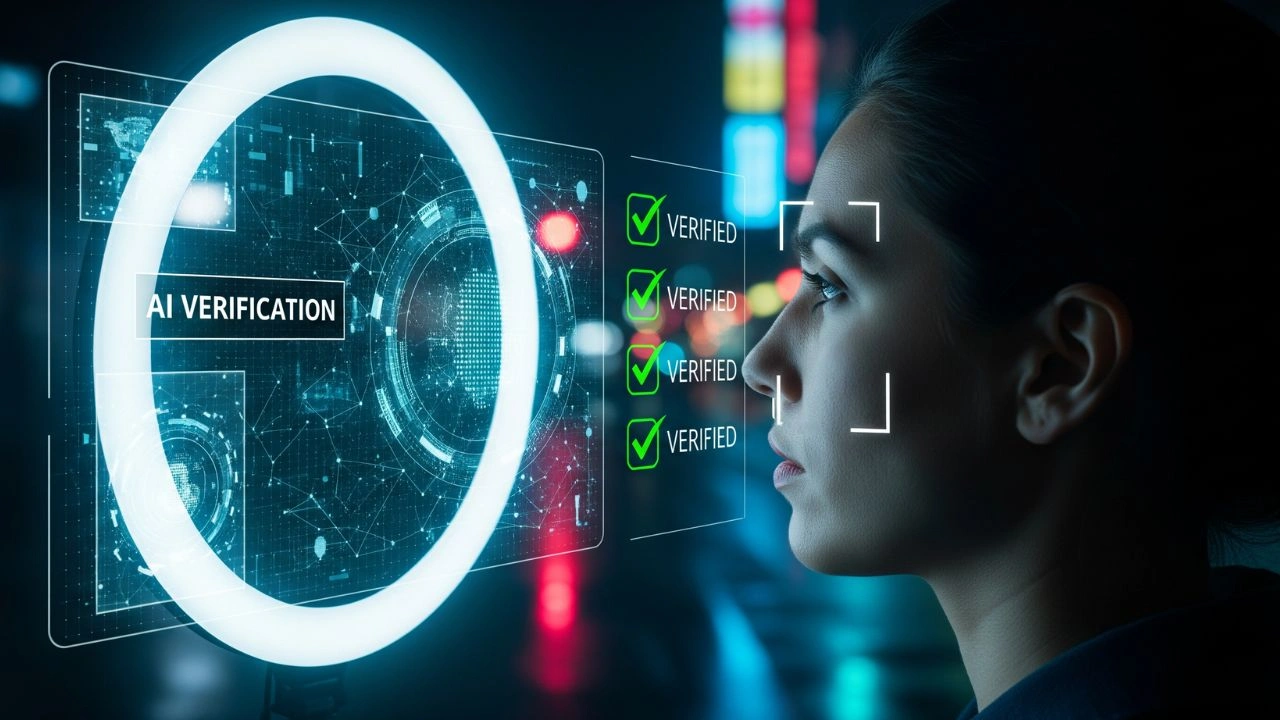
AI-Driven Identity Verification: In an increasingly digital world, identity has become the new currency. From opening a bank account and accessing healthcare to signing up for online services and remote work platforms, verifying who you are has never been more critical—or more challenging.
To meet this demand, companies and governments are rapidly adopting AI-driven identity verification systems. These systems promise faster onboarding, lower fraud, and seamless user experiences. But behind the promise lies a critical question that affects millions of users:
Is AI-driven identity verification truly secure—or are we placing blind trust in algorithms we don’t fully understand?
This article explores how AI-based identity verification works, where it excels, where it fails, and whether it can be trusted in real-world applications. We’ll cut through hype, address privacy and security concerns, and help businesses and individuals make informed decisions.
What Is AI-Driven Identity Verification?
AI-driven identity verification uses artificial intelligence and machine learning to confirm that a person is who they claim to be—digitally and remotely.
Unlike traditional identity checks that rely heavily on manual review or static credentials, AI systems:
- Analyze biometric data
- Detect fraud patterns
- Verify documents automatically
- Continuously learn from new threats
These systems are now widely used by:
- Banks and fintech companies
- Government portals
- Cryptocurrency exchanges
- Healthcare platforms
- Remote hiring and gig-economy apps
How AI-Based Identity Verification Works
To understand security, we must first understand how these systems operate.
1. Document Verification
AI analyzes identity documents such as:
- Passports
- National ID cards
- Driver’s licenses
Using computer vision, AI checks:
- Font consistency
- Security holograms
- MRZ codes
- Signs of tampering or forgery
2. Biometric Authentication
AI verifies physical traits like:
- Facial recognition
- Fingerprints
- Iris or voice recognition
It compares live data with stored references to confirm identity.
3. Liveness Detection
To prevent spoofing, AI checks whether the user is physically present by:
- Detecting eye movement
- Analyzing micro-expressions
- Identifying depth and lighting inconsistencies
This blocks attacks using photos, videos, or masks.
4. Behavioral Analysis
Advanced systems analyze:
- Typing patterns
- Device usage
- Navigation behavior
Unusual behaviour triggers additional verification.
Read Also: How AI Increases Efficiency in Solar Panels and Maximizes Clean Energy Output
Why Companies Are Adopting AI Identity Verification
Traditional identity verification is:
- Slow
- Expensive
- Error-prone
- Vulnerable to human bias
AI-driven systems offer:
- Instant verification
- 24/7 availability
- Reduced onboarding friction
- Scalability across millions of users
For companies, this translates into:
- Lower fraud losses
- Better user experience
- Faster customer acquisition
The Security Strengths of AI-Driven Identity Verification
1. Superior Fraud Detection Capabilities
AI can analyze millions of data points in seconds—far beyond human capacity.
It excels at detecting:
- Synthetic identities
- Deepfake attempts
- Reused or altered documents
- Coordinated fraud networks
AI improves continuously as it learns from new fraud patterns.
2. Reduced Human Error
Manual verification suffers from:
- Fatigue
- Inconsistent judgment
- Limited attention
AI systems apply consistent rules and logic, reducing subjective errors and insider threats.
3. Continuous Authentication
Unlike static passwords or ID checks, AI systems can:
- Monitor behavior continuously
- Re-verify identity in real time
- Flag suspicious activity immediately
This makes account takeovers far more difficult.
4. Stronger Biometric Security
Biometric traits are:
- Harder to steal than passwords
- Unique to individuals
- Difficult to replicate accurately
When combined with liveness detection, biometrics provide strong protection—if implemented correctly.
The Hidden Risks of AI-Driven Identity Verification
Despite its strengths, AI identity verification is not foolproof.
1. Deepfake and AI-Generated Fraud
Ironically, AI is also used by criminals.
Fraudsters now exploit:
- AI-generated faces
- Voice cloning
- Video deepfakes
Some advanced attacks can bypass weak liveness detection systems.
2. Bias and Accuracy Concerns
AI systems are only as good as their training data.
Poorly trained models can:
- Misidentify certain ethnic groups
- Have higher false rejection rates
- Discriminate unintentionally
This raises serious ethical and legal concerns.
3. Data Privacy and Surveillance Risks
Identity verification systems collect extremely sensitive data:
- Biometric information
- Government ID numbers
- Facial images
If mishandled, this data can be:
- Stolen in breaches
- Misused for surveillance
- Shared without consent
Biometric data cannot be changed like passwords.
4. Centralized Data Storage Vulnerabilities
Large identity databases become high-value targets for hackers.
A single breach can expose:
- Millions of identities
- Permanent biometric data
Security depends heavily on:
- Encryption standards
- Access controls
- Vendor practices
Is AI Identity Verification Safer Than Traditional Methods?
Traditional Methods Are Vulnerable to:
- Password reuse
- Phishing attacks
- Insider fraud
- Manual errors
AI-Driven Systems Offer:
- Multi-layered security
- Real-time fraud detection
- Reduced reliance on static credentials
However, AI is not automatically safer—it is safer only when implemented responsibly.
The Role of Regulation and Compliance
AI identity verification must comply with:
- GDPR (Europe)
- CCPA (California)
- KYC and AML laws
- Data protection regulations
Secure systems must ensure:
- Explicit user consent
- Data minimization
- Clear retention policies
- Right to deletion
Compliance is a critical trust factor.
Can AI Identity Verification Be Hacked?
Short answer: Yes—but so can any system.
The real question is:
How difficult is it to break compared to alternatives?
Well-designed AI systems are significantly harder to exploit than:
- Password-based logins
- SMS OTPs
- Static document uploads
But poorly implemented AI solutions can be worse than traditional systems.
Best Practices for Secure AI-Driven Identity Verification
For Companies
- Use multi-factor verification (biometrics + documents)
- Choose vendors with transparent security audits
- Encrypt biometric data end-to-end
- Avoid storing raw biometric data
- Regularly test systems against deepfake attacks
For Users
- Verify the legitimacy of platforms requesting biometric data
- Avoid sharing identity documents unnecessarily
- Read privacy policies carefully
- Use platforms that offer data deletion options
The Future of AI Identity Verification
Emerging trends include:
- Decentralized identity (DID)
- Blockchain-based credentials
- On-device biometric processing
- Zero-knowledge proof verification
These approaches aim to:
- Reduce centralized data storage
- Increase user control
- Improve privacy without sacrificing security
Ethical Questions We Cannot Ignore
Even secure AI systems raise concerns:
- Who owns biometric data?
- Can identity be revoked or corrected?
- How transparent are AI decisions?
Trust requires:
- Accountability
- Explainability
- Human oversight
Without these, security alone is not enough.
Read Also: How AI Learns: The Science of Machine Learning Explained
Real-World Use Cases: Where AI Identity Verification Works Best
AI identity verification is most effective in:
- Banking and fintech onboarding
- Cross-border digital services
- Gig-economy platforms
- Remote work verification
- Government e-services
These environments benefit from:
- Speed
- Scale
- Fraud prevention
When AI Identity Verification May Not Be Ideal
It may struggle in:
- Low-connectivity regions
- Populations with limited digital literacy
- Situations requiring human judgment
Hybrid systems combining AI and human review often work best.
Conclusion: Is AI-Driven Identity Verification Really Secure?
Yes—but with conditions.
AI-driven identity verification is significantly more secure than traditional methods when:
- Built with strong privacy safeguards
- Trained on diverse datasets
- Regularly updated against new threats
- Supported by clear regulations
However, it is not a silver bullet. Blind trust in AI without transparency, ethics, and governance creates new risks.
The future of digital identity lies not in choosing between AI and humans—but in combining intelligent automation with responsible oversight.