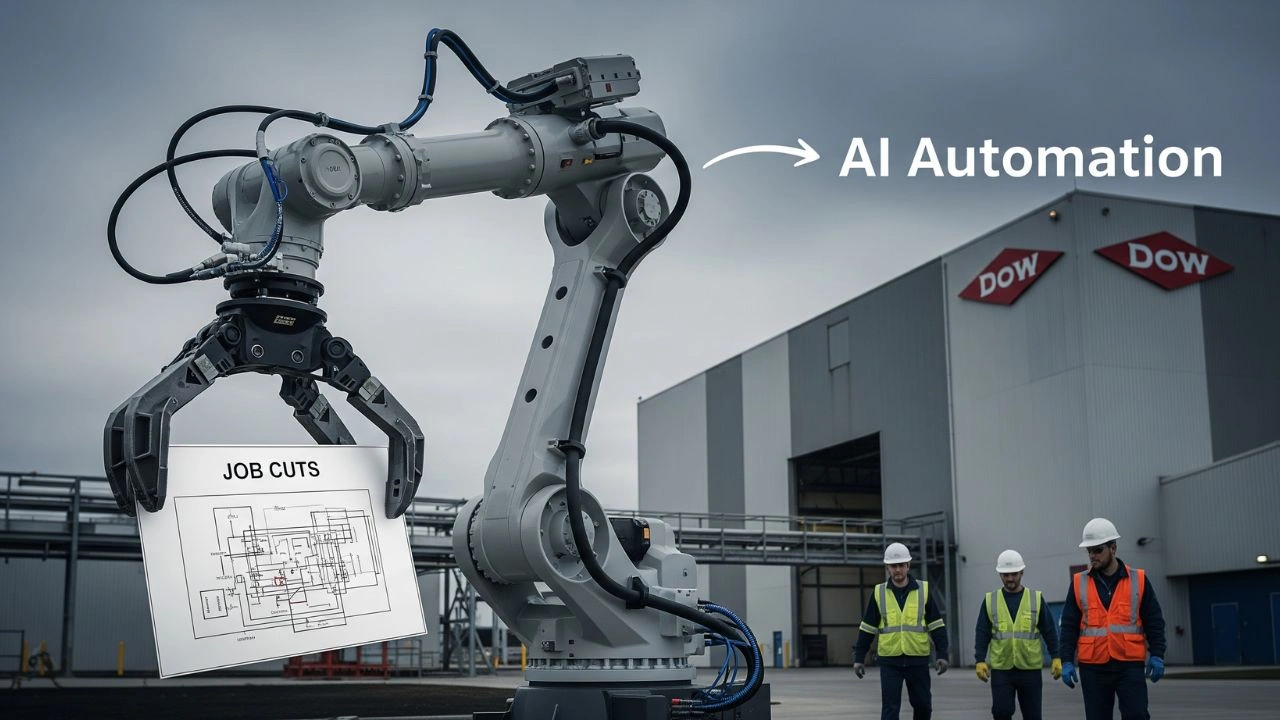
Dow job cuts AI automation: Dow Inc., one of the world’s largest chemical manufacturing companies, has announced plans to cut approximately 4,500 jobs globally as part of a broad restructuring strategy driven by artificial intelligence (AI), automation, and operational simplification. The move marks one of the most significant workforce reductions in the company’s recent history and highlights how AI-driven transformation is reshaping even traditional industrial sectors.
The decision has sparked widespread discussion across business, labor, and technology circles, raising important questions about the future of work, corporate responsibility, and the pace at which automation is being adopted across global industries.
While Dow says the changes are necessary to improve efficiency and long-term competitiveness, the announcement also reflects a broader trend: AI is no longer confined to tech companies—it is now a key driver of restructuring across manufacturing, logistics, and industrial enterprises.
What Dow Announced: Key Details of the Job Cuts
Dow confirmed that the layoffs will affect roughly 4,500 employees worldwide, representing a notable portion of its global workforce of around 34,600 workers. According to the company, the job cuts are part of a multi-year effort to simplify operations, reduce costs, and invest more heavily in digital tools, AI systems, and automation technologies.
Key Points from the Announcement:
- Around 4,500 positions to be eliminated
- Layoffs spread across multiple regions and business units
- Estimated $600 million to $800 million in severance and restructuring costs
- Focus on automation, AI-driven processes, and efficiency gains
- Part of a broader transformation strategy, not a short-term reaction
The market reacted quickly to the news, with Dow’s shares dipping shortly after the announcement, reflecting investor concern about restructuring costs and near-term uncertainty.
Read Also: AI Video Tools That Turn Blog Posts into Videos 2026 Guide
Why Dow Is Turning to AI and Automation
1. Pressure to Improve Efficiency
Like many large industrial companies, Dow operates in a highly competitive global market with fluctuating raw material costs, energy prices, and demand cycles. AI and automation offer ways to:
- Optimize production processes
- Reduce downtime
- Improve supply chain forecasting
- Lower long-term operating costs
By automating repetitive and data-heavy tasks, Dow aims to create leaner operations that can respond faster to market changes.
2. Digital Transformation of Manufacturing
Manufacturing is undergoing a digital revolution. AI systems are now capable of:
- Predictive maintenance for machinery
- Real-time quality control
- Energy usage optimization
- Advanced chemical process modeling
Dow has been investing in digital manufacturing tools for several years, and the latest job cuts signal a deeper shift toward AI-led decision-making and automated workflows.
3. Simplifying Complex Business Structures
Dow’s leadership has emphasized the need to reduce organizational complexity. Over time, large corporations tend to accumulate overlapping roles, legacy systems, and inefficient processes. AI allows companies to:
- Consolidate functions
- Automate reporting and analytics
- Reduce manual administrative work
This restructuring aims to create a more streamlined organization aligned with modern digital operations.
A Pattern, Not an Isolated Case
Dow’s announcement does not exist in isolation. Over the past year, several major corporations have announced layoffs linked—directly or indirectly—to AI and automation.
Similar Trends Across Industries:
- Technology companies reducing staff as AI tools replace internal processes
- Logistics and retail firms automating warehouses and customer support
- Financial institutions using AI for risk analysis and customer onboarding
- Manufacturing giants deploying smart factories and digital twins
This pattern suggests a structural shift in how companies view labor, productivity, and technology.
Impact on Employees and Communities
Human Cost of Automation
While AI-driven efficiency may benefit companies, the impact on workers is profound. Job losses affect:
- Household incomes
- Local economies
- Worker morale and trust
Many of the roles affected are likely tied to administrative, operational, or process-driven functions—areas where AI excels.
For affected employees, the transition can be emotionally and financially challenging, especially for those whose skills are closely tied to traditional industrial roles.
Reskilling and Redeployment Challenges
Dow has indicated that it will support affected employees through severance packages and transition assistance. However, the larger question remains: How easily can displaced workers reskill for AI-era jobs?
AI transformation often creates new roles in:
- Data analysis
- Digital operations
- Systems monitoring
- AI governance
But these roles typically require different skill sets, raising concerns about workforce readiness and access to retraining.
Investor and Market Perspective
From an investor standpoint, Dow’s move reflects a long-term strategy to remain competitive in an increasingly digital industrial landscape.
Potential Positives for Investors:
- Lower operating costs over time
- Improved margins through efficiency
- Stronger positioning against global competitors
- Alignment with future manufacturing trends
Short-Term Risks:
- High restructuring costs
- Potential disruption to operations
- Negative public perception
- Employee attrition beyond planned cuts
Markets often react cautiously to large layoffs, balancing cost savings against execution risks.
AI in Manufacturing: A Broader Industry Shift
How AI Is Changing Industrial Work
AI in manufacturing is no longer experimental. It is being actively deployed for:
- Process automation
- Demand forecasting
- Inventory optimization
- Safety monitoring
- Environmental compliance
For companies like Dow, AI is not just a cost-cutting tool—it is becoming central to how decisions are made across the organization.
From Human-Centered to Hybrid Operations
The future of industrial work is increasingly hybrid, where humans oversee, manage, and optimize AI systems rather than perform repetitive tasks themselves.
This transition:
- Reduces demand for some roles
- Increases demand for digital and analytical skills
- Changes the nature of industrial employment
Dow’s restructuring is a reflection of this evolving model.
Policy and Ethical Questions Raised by AI-Driven Layoffs
Should Companies Be Required to Retrain Workers?
As AI adoption accelerates, policymakers and labor organizations are asking whether companies should bear greater responsibility for workforce transitions.
Key questions include:
- Should firms invest more in reskilling programs?
- Should governments provide incentives for retraining?
- How can workers be protected from rapid displacement?
Dow’s case adds urgency to these debates.
Transparency and Corporate Responsibility
Another concern is transparency. Employees and the public increasingly expect companies to:
- Clearly explain why jobs are being cut
- Demonstrate responsible AI use
- Balance shareholder value with social impact
How Dow manages communication and post-layoff support will influence its public reputation.
What This Means for the Future of Work
Dow’s announcement is a signal—not just to employees, but to the global workforce.
Key Takeaways:
- AI adoption is accelerating beyond tech companies
- Automation is reshaping even traditional industries
- Job security increasingly depends on adaptability
- Digital and analytical skills are becoming essential
Workers, educators, and policymakers must prepare for a future where AI literacy and continuous learning are critical to career resilience.
Read Also: AI Chips and Semiconductors: Why NVIDIA Is Dominating the AI Market
Can AI and Jobs Coexist?
While headlines often focus on job losses, AI also creates opportunities:
- New technical and supervisory roles
- Higher productivity with fewer manual tasks
- Safer and more efficient workplaces
The challenge lies in managing the transition fairly and sustainably.
Dow’s restructuring highlights the need for:
- Proactive reskilling strategies
- Collaboration between companies and governments
- Ethical AI deployment
Conclusion: A Defining Moment in Industrial Transformation
Dow’s decision to cut 4,500 jobs as it accelerates AI and automation adoption marks a defining moment—not just for the company, but for the industrial sector as a whole.
The move underscores a reality that is becoming impossible to ignore: AI is fundamentally changing how work is organized, valued, and performed. For companies, it offers efficiency and competitiveness. For workers, it brings uncertainty—but also the possibility of new roles and skills.
How businesses, governments, and societies respond to this shift will determine whether AI-driven transformation leads to widespread prosperity or deeper inequality.
One thing is clear: the future of work is no longer theoretical—it is happening now.
3 thoughts on “Dow to Cut 4,500 Jobs as AI and Automation Reshape the Company’s Future”