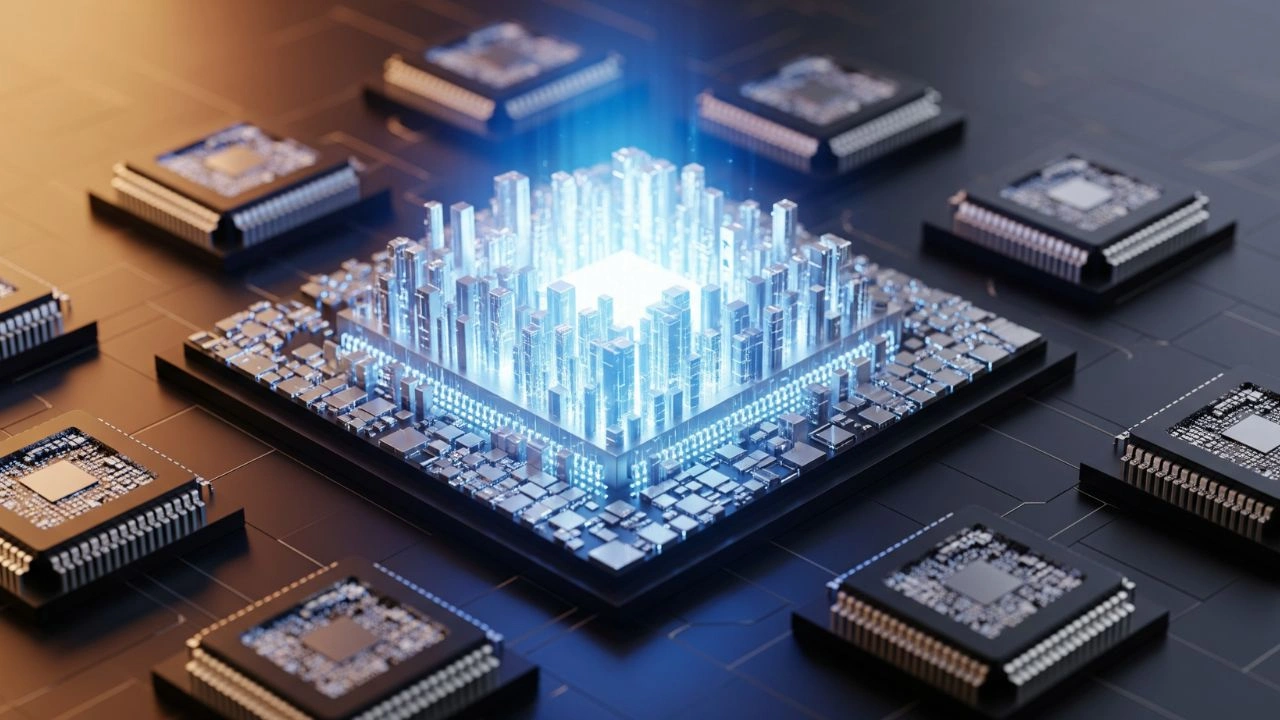
AI Chips and Semiconductors: Artificial intelligence may look like software—chatbots, image generators, autonomous systems—but AI’s true power comes from hardware. Every AI model, from simple recommendation systems to massive generative models, relies on enormous computing power. At the heart of this computing revolution lies AI chips and semiconductors, and one company stands above all others: NVIDIA.
Once known primarily for gaming graphics cards, NVIDIA has transformed itself into the backbone of the global AI economy. Today, nearly every major AI breakthrough—from large language models to autonomous vehicles—runs on NVIDIA hardware.
This article explains why NVIDIA dominates the AI chip and semiconductor market, how it built this advantage, why competitors are struggling to catch up, and what this means for the future of AI.
Understanding AI Chips: Why Semiconductors Matter So Much
AI models require enormous amounts of computation. Traditional CPUs are not designed for this kind of workload.
What Makes AI Different?
AI workloads involve:
- Massive parallel calculations
- Matrix and vector operations
- Continuous training on huge datasets
This is where specialized AI chips become essential.
Key Types of AI Chips
- CPUs – General-purpose, slow for AI
- GPUs – Highly parallel, ideal for AI
- TPUs – Custom AI chips (limited ecosystems)
- ASICs – Specialized, inflexible
Among these, GPUs have emerged as the dominant AI computing platform, and NVIDIA owns this space.
Read Also: Writesonic Review: Best AI Tool for SEO & Scalable Content Creation
NVIDIA’s Origin Story: From Gaming to AI Supremacy
NVIDIA was founded in 1993 with a focus on graphics processing. For years, its GPUs were primarily used for:
- PC gaming
- Professional visualization
- Graphics rendering
The turning point came when researchers realized GPUs were perfect for parallel computation, which is exactly what AI requires.
A Critical Insight
Instead of being just graphics chips, GPUs could become:
- Scientific computing accelerators
- Machine learning engines
- AI training powerhouses
NVIDIA saw this opportunity before almost anyone else.
CUDA: NVIDIA’s Most Powerful Weapon
If NVIDIA has a secret weapon, it is not hardware—it is CUDA.
What Is CUDA?
CUDA (Compute Unified Device Architecture) is NVIDIA’s proprietary software platform that allows developers to:
- Program GPUs easily
- Accelerate computation
- Optimize AI workloads
CUDA was launched in 2006—years before the AI boom.
Why CUDA Changed Everything
CUDA created:
- A massive developer ecosystem
- Thousands of optimized AI libraries
- Deep integration with research and enterprise software
Today, most AI frameworks are built around CUDA, making NVIDIA GPUs the default choice.
Hardware Leadership: NVIDIA’s AI Chips Explained
NVIDIA GPUs for AI
NVIDIA designs GPUs specifically for AI workloads, not just graphics.
Key product categories include:
- Data center GPUs
- AI accelerators
- Networking and interconnect solutions
These chips are designed for:
- High memory bandwidth
- Massive parallelism
- Energy efficiency at scale
NVIDIA and Data Centers: Owning the AI Infrastructure
AI training happens in data centers, not personal computers.
Why Data Centers Matter
Training large AI models requires:
- Thousands of GPUs
- High-speed interconnects
- Specialized cooling and power management
NVIDIA dominates this environment.
NVIDIA’s Data Center Advantage
- GPUs optimized for AI training
- High-speed networking (NVLink, InfiniBand)
- Software optimized for scale
Major cloud providers rely heavily on NVIDIA hardware.
The Software Stack: NVIDIA’s Unmatched Ecosystem
NVIDIA does not sell chips alone—it sells complete AI platforms.
NVIDIA’s AI Software Stack Includes:
- CUDA
- cuDNN (deep learning library)
- TensorRT (AI inference optimization)
- AI frameworks and SDKs
This ecosystem reduces development time and increases performance, making NVIDIA irreplaceable for many organizations.
Why Competitors Are Struggling to Catch Up
AMD: Strong Hardware, Weaker Ecosystem
AMD produces powerful GPUs, but:
- Software support lags behind CUDA
- Smaller AI developer community
- Limited enterprise AI adoption
Hardware alone is not enough in AI.
Intel: Late to the AI Acceleration Game
1. Intel dominates CPUs but:
- CPUs are inefficient for AI workloads
- AI accelerators arrived late
- Fragmented software strategy
Intel is improving, but NVIDIA’s lead is significant.
Custom AI Chips: Limited Flexibility
Some companies design their own AI chips, but:
- High development cost
- Limited use cases
- Small software ecosystems
Most organizations still prefer NVIDIA’s general-purpose AI GPUs.
NVIDIA’s Strategic Partnerships
NVIDIA works closely with:
- Cloud service providers
- Universities and research labs
- Automotive manufacturers
- Healthcare and robotics companies
This ensures NVIDIA hardware becomes the default AI platform across industries.
AI Training vs AI Inference: NVIDIA Wins Both
AI Training
Training large models requires:
- Maximum performance
- Scalability
- Reliability
NVIDIA dominates training workloads.
AI Inference
Inference requires:
- Low latency
- Energy efficiency
- Optimization
NVIDIA’s software tools make inference faster and cheaper.
Economic Moat: Why NVIDIA’s Lead Is Hard to Break
NVIDIA’s dominance is protected by:
- Software lock-in
- Developer familiarity
- Proven reliability
- Continuous innovation
Switching away from NVIDIA often costs more than staying, even if alternatives exist.
NVIDIA’s Role in Generative AI
Generative AI models require unprecedented computing power.
Why NVIDIA Is Central to Generative AI
- GPUs handle massive neural networks
- Memory bandwidth supports large models
- Optimized training pipelines
Most generative AI breakthroughs run on NVIDIA hardware.
Energy Efficiency and Sustainability
AI consumes significant energy.
NVIDIA focuses on:
- Performance per watt
- Efficient scaling
- Optimized cooling solutions
This makes NVIDIA more attractive for large-scale deployments.
Supply Chain and Manufacturing Strategy
NVIDIA does not manufacture chips itself.
Why This Works
- Partners with leading chip manufacturers
- Focuses on design and innovation
- Flexible production strategy
This allows NVIDIA to adapt quickly to demand.
Risks and Challenges NVIDIA Faces
Despite its dominance, challenges exist.
Key Risks:
- Supply constraints
- Geopolitical tensions
- Rising competition
- Regulatory scrutiny
However, NVIDIA’s diversification across industries reduces risk.
What NVIDIA’s Dominance Means for the AI Industry
Positive Impacts:
- Faster AI innovation
- Standardized AI development
- Lower barrier for AI adoption
Potential Concerns:
- Market concentration
- Dependency on a single vendor
Balanced competition will be important long-term.
The Future of AI Chips: Can NVIDIA Stay on Top?
NVIDIA continues to invest heavily in:
- New architectures
- AI-specific accelerators
- Software innovation
As long as AI remains computation-intensive, NVIDIA is well-positioned to lead.
Read Also: Leading AI Companies in 2025-26: Who’s Winning the Global AI Race?
How Businesses and Developers Benefit from NVIDIA’s Leadership
For users, NVIDIA dominance means:
- Stable platforms
- Extensive documentation
- Faster development cycles
This accelerates AI adoption across sectors.
Conclusion: Why NVIDIA’s Dominance Is Not Accidental
NVIDIA did not dominate the AI chip market by chance. Its leadership is the result of:
- Early vision
- Software-first strategy
- Deep ecosystem investment
- Continuous innovation
While competitors will improve, NVIDIA’s decade-long head start gives it a powerful advantage.
AI is not just about algorithms—it is about who controls the compute.
Right now, that company is NVIDIA.
1 thought on “AI Chips and Semiconductors: Why NVIDIA Is Dominating the AI Market”