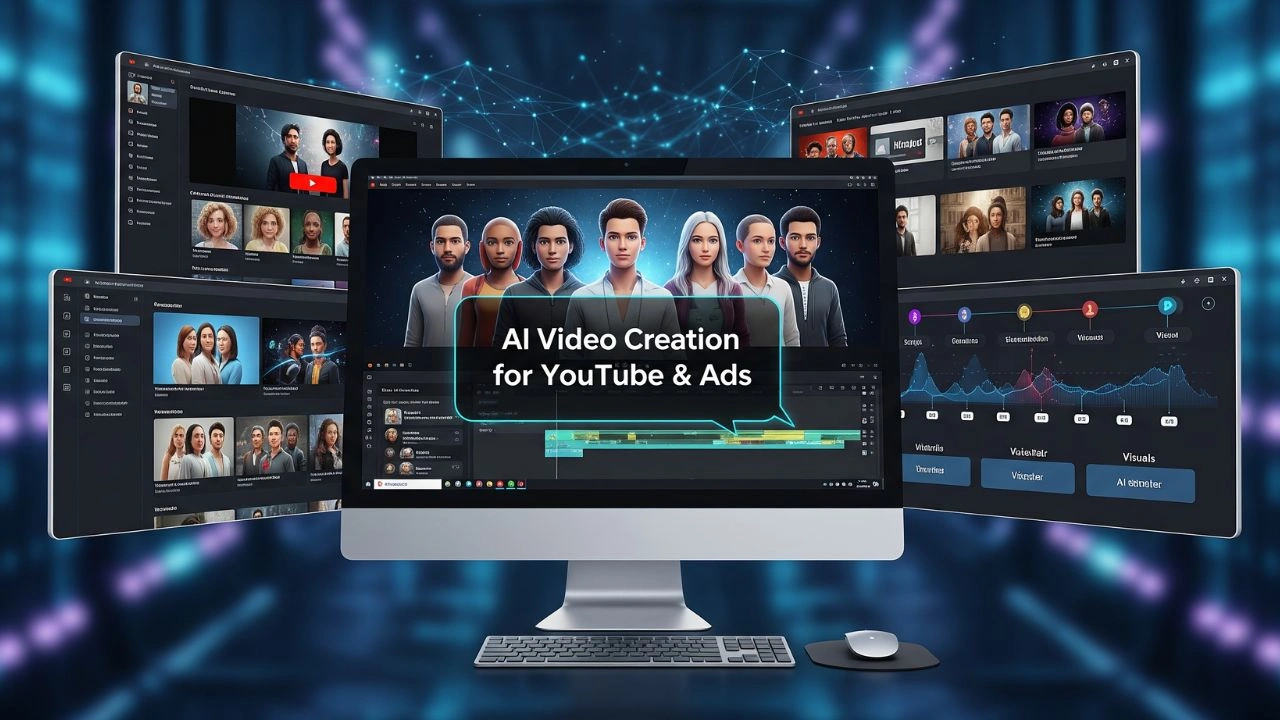
Video has become the most powerful form of digital communication. From YouTube content and social media ads to brand storytelling and performance marketing, video dominates how businesses attract, engage, and convert audiences. However, traditional video production is often expensive, time-consuming, and resource-intensive. This challenge has opened the door for a revolutionary solution: AI video creation.
AI video creation tools are transforming how businesses and creators produce videos for YouTube and advertising platforms. By automating scripting, editing, animation, voiceovers, and personalization, generative AI enables high-quality video production at scale. This article explores how AI video creation works, its benefits for YouTube and ads, the key use cases, and why it is reshaping the future of video marketing.
The Rise of AI in Video Creation
Artificial intelligence has evolved from basic automation into systems capable of generating realistic visuals, human-like voices, animations, and storytelling structures. In video creation, AI can now transform text into videos, images into animations, and data into engaging visual narratives.
The rapid growth of video platforms such as YouTube, TikTok, Instagram, and connected TV advertising has dramatically increased demand for video content. At the same time, marketing teams face tighter budgets and shorter timelines. AI video creation bridges this gap by delivering speed, scalability, and affordability.
Businesses no longer need full production crews or advanced editing skills to produce professional-quality videos. With AI tools, a single marketer or creator can produce dozens of videos in the time it once took to make one.
Read Also: Jasper AI Review 2025: Features, Pricing, Pros & Cons – Is Jasper Worth It?
How AI Video Creation Works
AI video creation tools rely on a combination of technologies, including machine learning, computer vision, natural language processing, and generative models. These systems analyze inputs such as scripts, prompts, images, or data and generate video outputs automatically.
Typical AI video workflows include:
- Text-to-video generation
- Script writing and scene planning
- Automated video editing and transitions
- AI voiceovers and subtitles
- Visual generation and animation
By learning from massive datasets of video content, AI models understand pacing, structure, and visual storytelling principles. This allows them to create videos that feel natural, engaging, and platform-optimized.
AI Video Creation for YouTube Content
YouTube is the world’s second-largest search engine and one of the most competitive content platforms. Consistency, quality, and relevance are critical for growth, yet producing regular YouTube videos is challenging.
AI video creation tools help YouTubers and brands generate content faster while maintaining high standards. Creators can use AI to:
- Turn blog posts or scripts into full videos
- Generate intros, outros, and transitions
- Create explainer videos and tutorials
- Produce faceless YouTube content
- Add automatic captions and translations
For educational channels, AI can visualize complex concepts through animations and data-driven visuals. For entertainment and commentary channels, AI accelerates editing and post-production. This allows creators to publish more frequently and grow their channels faster.
AI-Powered Video Ads for Digital Marketing
Video advertising is one of the most effective ways to drive conversions, but producing ad creatives at scale is costly. AI video creation tools have become essential for performance marketers running ads on YouTube, Facebook, Instagram, TikTok, and Google Display.
AI enables advertisers to generate multiple video ad variations quickly. Headlines, visuals, calls to action, and formats can be customized for different audiences and platforms. AI tools analyze performance data to identify which variations convert best and automatically optimize future creatives.
This approach supports rapid A/B testing and iteration, ensuring ad budgets are spent on high-performing videos. AI-generated video ads deliver better ROI with lower production costs.
Text-to-Video and Script Automation
One of the most powerful features of AI video creation is text-to-video generation. Marketers and creators can input a script, blog article, or even bullet points, and AI transforms it into a complete video.
AI handles scene selection, visuals, animations, transitions, and pacing automatically. This dramatically reduces the time spent on storyboarding and editing.
Script automation also plays a key role. AI tools generate video scripts optimized for YouTube retention or ad conversions. They consider factors such as hook timing, message clarity, and emotional engagement. This ensures videos are not only produced quickly but are strategically effective.
AI Voiceovers and Multilingual Video Content
Voiceovers are a critical element of video production, yet hiring voice actors and recording audio can be expensive and slow. AI voice generation solves this problem by producing realistic, natural-sounding voices in multiple languages and tones.
Businesses use AI voiceovers to:
- Create explainer and tutorial videos
- Localize content for global audiences
- Personalize video ads at scale
- Maintain consistent brand voice
AI also enables automatic translation and dubbing, making it easy to repurpose videos for international markets. This expands reach while keeping localization costs low.
Visual Generation and AI Avatars
Generative AI has made it possible to create visuals and on-screen presenters without cameras or studios. AI avatars can deliver scripts in a human-like manner, making videos more engaging and professional.
These avatars are particularly useful for:
- Corporate training videos
- Product demos
- Sales and onboarding content
- Educational YouTube channels
AI-generated visuals and animations also help illustrate abstract ideas, data insights, and processes. By reducing reliance on stock footage or custom design, businesses achieve faster turnaround times and creative flexibility.
Personalization at Scale for Video Ads
Personalization is a major driver of advertising success, and AI video creation makes it scalable. AI tools can generate personalized video ads based on user data such as location, interests, behavior, or stage in the customer journey.
For example, an e-commerce brand can create thousands of video variations showing different products, prices, or messages for different audiences. AI assembles these videos automatically, ensuring relevance without manual effort.
Personalized video ads consistently outperform generic creatives, leading to higher engagement, click-through rates, and conversions.
AI Video Editing and Post-Production Automation
Editing is one of the most time-consuming aspects of video creation. AI automates editing tasks such as cutting, trimming, transitions, color correction, music selection, and subtitle generation.
AI tools analyze footage and identify key moments, removing silences or filler content automatically. They also optimize videos for specific platforms by adjusting aspect ratios, lengths, and formats.
For YouTube creators and advertisers alike, AI-driven editing significantly reduces production time while improving consistency and quality.
SEO and Performance Optimization for YouTube Videos
Success on YouTube depends heavily on discoverability and retention. AI tools help optimize videos for YouTube SEO by generating titles, descriptions, tags, and thumbnails designed to maximize clicks.
AI also analyzes audience retention data, watch time, and engagement to recommend improvements in pacing and structure. Some tools even predict how a video is likely to perform before publishing.
By combining video creation with performance optimization, AI helps creators and brands achieve better visibility and faster channel growth.
Cost Efficiency and Scalability
Traditional video production often requires cameras, studios, editors, designers, and voice talent. AI video creation drastically reduces these costs by consolidating multiple roles into a single platform.
Small teams can produce enterprise-level video content without outsourcing or expanding headcount. At the same time, AI enables scalability—creating one video or one thousand requires minimal additional effort.
This makes AI video creation especially valuable for startups, agencies, and performance-driven marketers.
Ethical Use and Brand Authenticity
While AI video creation offers immense advantages, responsible use is essential. Businesses must ensure transparency, avoid misleading content, and maintain brand authenticity.
Human oversight remains critical for storytelling, emotional nuance, and ethical decision-making. AI should be viewed as a creative partner, not a replacement for human judgment.
Brands that use AI thoughtfully build trust while benefiting from innovation and efficiency.
Read Also: ChatGPT Review 2025: Features, Pricing, Pros & Cons – Is It Worth Using?
The Future of AI Video Creation
The future of AI video creation points toward even greater automation and realism. AI tools will become capable of managing entire video campaigns—from ideation and production to optimization and reporting.
We can expect more interactive videos, real-time personalization, and deeper integration with advertising and analytics platforms. AI-generated content will continue to improve in quality, creativity, and emotional intelligence.
Video creation will become faster, smarter, and more accessible than ever before.
Conclusion
AI video creation for YouTube and ads is transforming how content is produced, scaled, and optimized. By automating scripting, editing, voiceovers, personalization, and performance optimization, AI empowers creators and businesses to produce high-impact videos with unprecedented efficiency.
In a digital world driven by video, AI provides a critical competitive advantage. Those who adopt AI video creation tools today can produce more content, reach wider audiences, and achieve better results—without the traditional barriers of cost and complexity.
AI is not just changing video creation; it is redefining what is possible in video marketing.