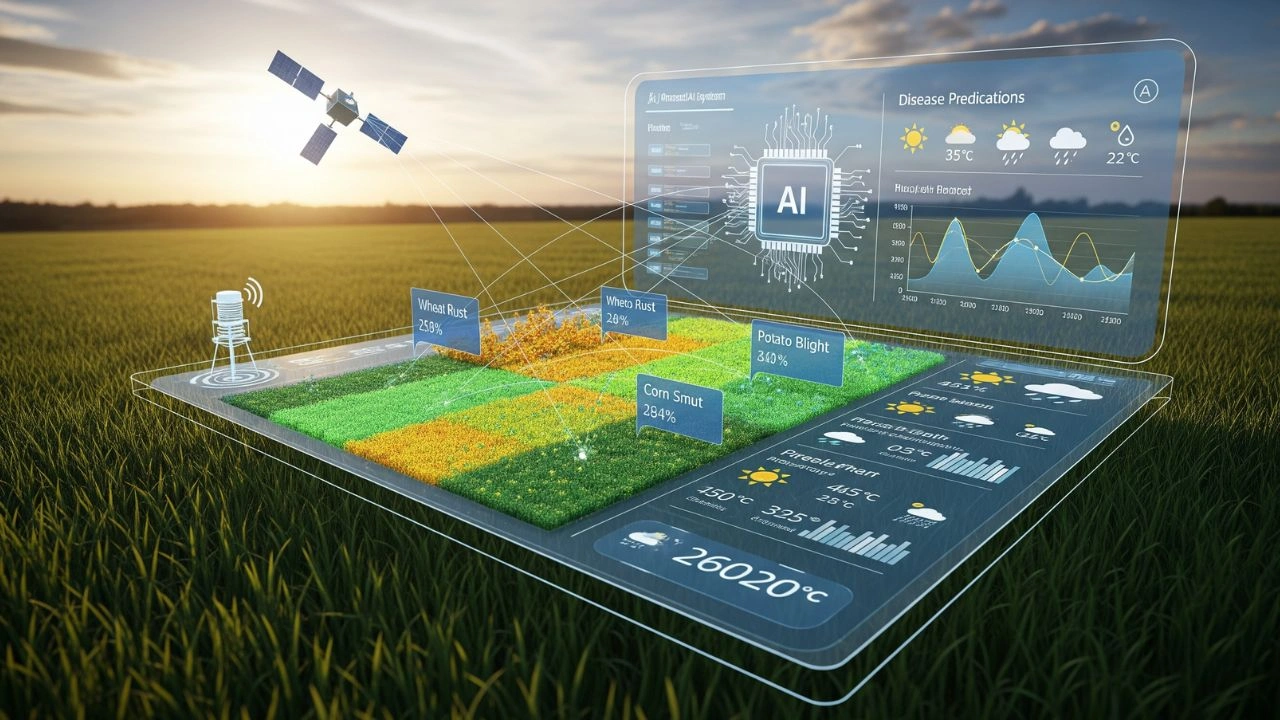
Agriculture has always depended on weather patterns and crop health. For centuries, farmers relied on experience, seasonal signs, and traditional knowledge. While this wisdom is invaluable, climate change, unpredictable weather, and emerging crop diseases have made farming far more complex than before.
This is where Artificial Intelligence (AI) is stepping in.
Across the world, AI-powered systems are being used to predict crop diseases, forecast weather, monitor soil conditions, and optimize farming decisions. But an important question remains:
Can AI really predict crop diseases and weather accurately, or is it just hype?
This article answers that question honestly and practically—covering how AI works, its accuracy, real-world use cases, benefits, limitations, and what farmers should realistically expect.
Understanding AI in Agriculture (Simple Explanation)
AI in agriculture does not mean robots replacing farmers. Instead, it refers to computer systems that analyze large amounts of agricultural data and provide insights.
AI in farming mainly uses:
- Machine Learning (ML) – learns patterns from past data
- Computer Vision – analyzes images of crops and leaves
- Data Analytics – processes weather, soil, and satellite data
- Predictive Models – estimates future outcomes like disease spread or rainfall
These technologies work together to support farmers, not replace them.
Read Also: Leading AI Companies in 2025-26: Who’s Winning the Global AI Race?
How AI Predicts Crop Diseases
1. Image-Based Disease Detection
One of the most accurate AI applications in agriculture is crop disease identification using images.
How it works:
- Farmers take photos of leaves using smartphones or drones
- AI models compare images with thousands of disease patterns
- The system identifies:
- Disease type
- Severity level
- Possible causes
Accuracy:
- Many AI models achieve 85–95% accuracy in controlled conditions
- Accuracy improves with:
- Clear images
- Localized datasets
- Regular model updates
This allows early detection, often before symptoms are visible to the human eye.
2. AI Using Weather & Environmental Data
Crop diseases are closely linked to:
- Temperature
- Humidity
- Rainfall
- Wind patterns
AI systems analyze historical and real-time weather data to predict:
- When disease conditions are likely to develop
- Which regions are at higher risk
For example:
- High humidity + warm temperatures → higher fungal disease risk
- Prolonged rainfall → bacterial disease spread
AI combines these factors to issue early warnings.
3. AI + Satellite & Drone Monitoring
Satellite images and drones provide:
- Crop stress indicators
- Color variations in plants
- Growth anomalies
AI detects subtle changes in crop health that humans might miss. This helps:
- Identify disease outbreaks early
- Limit spread to nearby fields
- Reduce unnecessary pesticide use
Can AI Predict Crop Diseases Accurately?
The honest answer:
Yes, AI can predict crop diseases accurately—but with conditions.
1. AI is highly accurate when:
- Local data is available
- Models are trained for specific crops
- Weather and soil data are updated regularly
- Farmers validate results with field inspection
2. AI struggles when:
- Data quality is poor
- Rare or new diseases appear
- Environmental conditions change suddenly
AI should be viewed as a decision-support tool, not a final authority.
How AI Predicts Weather for Agriculture
Weather forecasting is one of AI’s strongest areas.
Traditional vs AI Weather Forecasting
| Traditional Forecasting | AI-Based Forecasting |
| Rule-based models | Pattern-based learning |
| Slower updates | Real-time adaptation |
| Limited local accuracy | Hyper-local predictions |
| Less crop-specific | Crop-focused insights |
AI Weather Prediction Methods
AI uses:
- Historical climate records
- Satellite imagery
- Sensor data from fields
- Real-time atmospheric data
It then predicts:
- Rainfall probability
- Temperature fluctuations
- Heatwaves
- Frost risk
- Drought patterns
Some systems can provide field-level weather insights, not just city-level forecasts.
Accuracy of AI Weather Predictions for Farming
AI weather predictions are:
- Very accurate for short-term forecasts (1–7 days)
- Moderately accurate for medium-term forecasts (10–15 days)
- Less reliable for long-term seasonal predictions
However, AI often outperforms traditional systems in:
- Local rainfall prediction
- Extreme weather alerts
- Micro-climate analysis
Real-World Applications of AI in Crop & Weather Prediction
1. Disease Early Warning Systems
- Alerts farmers before disease spreads
- Reduces crop loss
- Minimizes pesticide overuse
2. Smart Spraying Decisions
- AI suggests when spraying is actually needed
- Saves cost and protects soil health
3. Yield Protection
- Weather alerts help farmers protect crops from frost, floods, or heat stress
4. Insurance & Risk Management
- AI data supports crop insurance claims
- Improves transparency and trust
Benefits of AI in Crop Disease & Weather Prediction
For Farmers
- Early problem detection
- Lower input costs
- Better planning
- Increased yields
For Environment
- Reduced chemical usage
- Efficient water use
- Lower carbon footprint
For Economy
- Reduced crop losses
- Improved food security
- Smarter agricultural investments
Limitations and Challenges of AI in Agriculture
Despite its promise, AI is not perfect.
Key limitations include:
- Dependence on quality data
- Limited access in remote areas
- Cost of advanced tools
- Need for farmer training
- Internet connectivity issues
AI cannot replace ground truth—physical field inspection remains essential.
AI in Agriculture: India & Global Perspective
In countries like India:
- AI is being used for:
- Pest detection
- Weather alerts via mobile apps
- Crop advisory systems
- Challenges include:
- Small land holdings
- Diverse crop varieties
- Language barriers
Globally:
- AI adoption is faster in large-scale farming
- Precision agriculture is becoming standard
Localized AI solutions are the key to wider success.
Ethics, Trust & EEAT Considerations
For AI in agriculture to be trusted:
- Predictions must be explainable
- Data sources should be transparent
- Farmers should remain decision-makers
- Human oversight is essential
AI should assist, not control, agricultural decisions.
Future of AI in Crop Disease & Weather Prediction
By 2030, AI in agriculture is expected to:
- Offer near real-time disease alerts
- Integrate weather + soil + crop models
- Become more affordable for small farmers
- Support climate-resilient farming
AI will evolve from reactive systems to preventive farming intelligence.
Read Also: Why Big Tech Is Racing to Control the Future of Artificial Intelligence
Conclusion: Can AI Predict Crop Diseases and Weather Accurately?
✅ Yes—with realistic expectations.
AI can:
Predict many crop diseases early
Improve short-term weather accuracy
Reduce farming risks
Support smarter decisions
But AI:
Is not 100% perfect
Cannot replace human judgment
Needs quality data and local adaptation
The best results come when AI and farmer experience work together.
Conclusion
AI is not magic—but it is powerful.
When used responsibly, AI can transform agriculture from reactive farming to predictive, sustainable farming. Crop disease prediction and weather forecasting are two areas where AI already delivers real, measurable value.
For farmers, policymakers, and agricultural stakeholders, the future is clear:
AI is not the future of farming—it is the present.