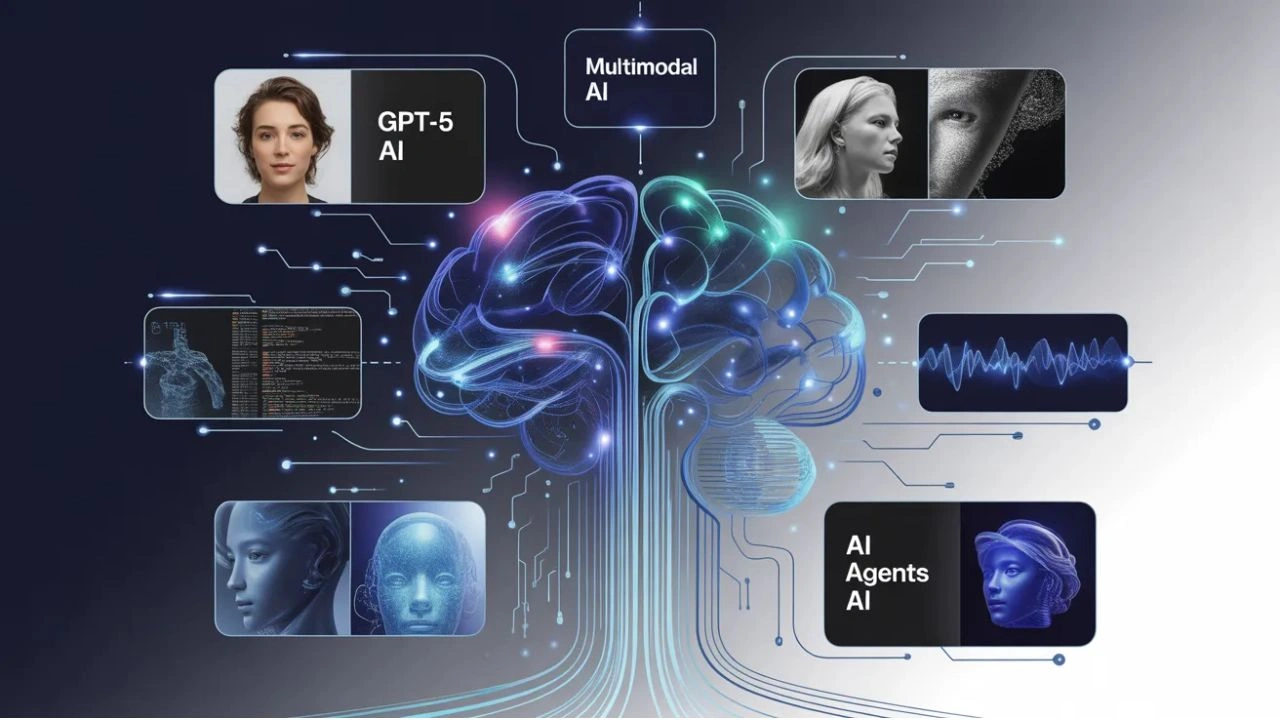
emerging trends in generative AI: Generative Artificial Intelligence (AI) stands at the forefront of transformative technology, reshaping how we create, innovate, and solve problems across industries. Beyond mere automation or classification tasks, generative AI systems can produce novel content—text, images, video, code, and even synthetic biological data—that was once exclusive to human creators. As the field evolves rapidly, staying current with emerging trends in generative AI and research directions is crucial for developers, businesses, academics, and policymakers alike.
This article provides a comprehensive, well-researched, and actionable overview of where generative AI is headed. It delves into technological breakthroughs, ethical considerations, safety research, industry adoption, and future horizons. Crucially, we focus not only on the “what” but also the “why” and “how,” offering insights that professionals and enthusiasts can directly apply in their work.
1. The Evolution of Generative AI: From GANs to Large Language Models
Generative AI research began gaining traction with Generative Adversarial Networks (GANs) in 2014, which enabled machines to generate realistic images and data samples. Over the years, the field expanded to include Variational Autoencoders (VAEs), transformer models, and most recently, large language and multimodal models.
Today’s generative models—like those powering powerful text generators—leverage massive pre-training on diverse datasets, enabling them to perform a wide range of tasks with minimal fine-tuning. This shift from task-specific models to generalist architectures has profound implications, allowing AI systems to adapt across contexts much like human cognition.
2. Multimodal Generative AI: Blurring the Boundaries Between Modalities
One of the most important trends in generative AI is the rise of multimodal models—systems that understand and generate multiple types of data (text, images, audio, etc.) simultaneously.
Why This Matters
Humans perceive the world through multiple senses. Multimodal AI can:
- Interpret complex situations by integrating different data sources.
- Generate richer content by combining text, images, and sound.
- Enable new user experiences such as voice-activated design or text-guided video creation.
Notable Research Directions
- Cross-modal Learning: Training models that can translate concepts across modalities, e.g., turning text prompts into realistic images or generating descriptive captions for video content.
- Unified Model Architectures: Moving toward single systems that handle text, vision, and audio seamlessly rather than specialized models for each.
Read Also: Governments Push for AI Identity Verification Systems: Benefits, Risks, and What Citizens Must Know
3. Explainability and Interpretability: Opening the Black Box
As generative AI models grow more powerful and complex, understanding how they make decisions becomes essential.
The Challenge
Modern models—especially deep neural networks—are notoriously opaque. Without clear visibility into their internal processes, it’s difficult to:
- Diagnose errors
- Ensure fairness
- Comply with regulations
- Build user trust
Research Directions
- Saliency Mapping & Attribution Tools: Techniques that highlight which parts of the input most influence the output.
- Interpretable Sub-Networks: Designing parts of a model that are human-readable and explainable by design.
- Hybrid Symbolic-Neural Systems: Combining logical reasoning with generative models to make decisions more actionable and understandable.
These efforts not only improve trust but also help developers build safer and more robust AI systems.
4. Responsible, Safe, and Ethical Generative AI
Generative AI can be used to create harmful content—deepfakes, misinformation, biased outputs, or unsafe code. Addressing these risks is one of the most urgent research priorities today.
Key Focus Areas
Bias Mitigation
Generative models often reflect biases present in their training data. Techniques being researched include:
- Debiasing during training
- Post-generation correction
- Context-aware fairness constraints
Safety and Alignment
Ensuring AI outputs align with human values and safety constraints remains a core challenge. Research in this area includes:
- AI alignment frameworks
- Reinforcement learning from human feedback (RLHF)
- Safety evaluation benchmarks
Content Attribution and Watermarking
Researchers are developing methods to watermark or tag generated content to:
- Detect AI-generated material
- Prevent misuse
- Trace origins of synthetic media
These efforts support transparency and accountability, critical elements for trustworthy AI.
5. Personalized and Adaptive AI Systems
Another emerging trend is the push toward user-aware generative AI—systems that tailor outputs based on individual preferences, styles, and behaviors.
Applications
- Personalized learning assistants
- Custom creative tools
- Adaptive customer service bots
Research Goals
- Learning user preferences with minimal data
- Balancing personalization with privacy
- Avoiding echo chambers while remaining helpful
AI systems that adapt intelligently to users will redefine digital interactions, creating highly engaging and efficient experiences.
6. Real-Time and Interactive Generation
Historically, powerful models required significant computation time. However, real-time generative AI is becoming increasingly feasible.
What’s Driving This?
- Hardware acceleration (TPUs, GPUs, custom AI chips)
- Efficient model architectures (sparse transformers, quantized models)
- Edge computing
Examples
- Live text suggestions in communication tools
- Real-time image or video editing
- Interactive design generation
This opens new possibilities for immersive applications in gaming, AR/VR, and creative production.
7. Integrating Generative AI in the Enterprise
Businesses across sectors are discovering practical use cases for generative AI, from automating content creation to design synthesis, customer engagement, and decision support.
High-Impact Enterprise Use Cases
- Marketing and Advertising: Automated creative generation tailored to audience segments.
- Software Development: AI-assisted code generation and debugging.
- Scientific Research: Hypothesis generation, simulation design, and data augmentation.
- Healthcare: Personalized treatment plan suggestions and medical report synthesis.
Organizations increasingly treat generative AI as a strategic asset. Emerging research focuses on enterprise-grade model governance, security, and interpretability to safely unlock these benefits.
8. Hybrid Models: Merging Rule-Based Logic and Learning
Purely data-driven generative models show remarkable capabilities, but integrating them with structured reasoning systems greatly enhances reliability and control.
Benefits of Hybrid Systems
- Grounded reasoning with symbolic logic
- Better handling of edge cases
- Reduced hallucinations in outputs
- Improved decision-making transparency
Research Frontiers
- Differentiable reasoning frameworks
- Neuro-symbolic integration at scale
- Domain-specific knowledge graphs driving generation
Hybrid systems promise robust AI that retains creativity while adhering to rules and logic—a key advantage for critical applications.
9. AI-Assisted Scientific Discovery
Generative AI is increasingly influencing scientific research itself—accelerating discovery in fields like chemistry, biology, and material science.
Breakthrough Areas
- Protein structure prediction
- Molecule synthesis planning
- Drug discovery hypothesis generation
- Climate modeling and prediction
Here, generative models help explore vast design spaces faster than traditional methods, offering possible solutions previously too complex to compute.
Research Challenges
- Ensuring scientific validity
- Integrating domain constraints
- Reducing computational cost
Generative AI’s role in scientific progress may change how discoveries happen, moving toward augmented scientific reasoning.
10. Generative AI and Synthetic Data
Data scarcity can hinder AI training, especially in sensitive domains like healthcare and finance. Synthetic data generation is a growing research direction to address this.
Why It Matters
Synthetic data can:
- Preserve privacy
- Augment training datasets
- Reduce cost of labeled data collection
Key Considerations
- Ensuring synthetic realism
- Avoiding leakage of training data
- Balancing diversity and fidelity
Emerging methods produce high-quality synthetic datasets that preserve statistical insights without exposing real individuals, facilitating safer machine learning.
11. Regulation and Policy: Shaping the Future of Generative AI
As generative AI influences society broadly, governments and international bodies are developing regulations to manage risks and unlock innovation.
Policy Goals
- Accountability for misuse
- Transparency in AI systems
- Protection of intellectual property
- Fair competition and non-discrimination
These frameworks are evolving alongside technology. Research in policy focuses on:
- Defining AI safety standards
- Enforcing ethical use guidelines
- Establishing audit mechanisms for generative systems
Responsible governance is becoming as critical as the technology itself.
Read Also: AI Video Automation Tools for Social Media Posting 2026 Guide
12. The Human-AI Partnership
One of the most transformative aspects of generative AI is its augmentation of human capabilities rather than outright replacement.
Collaborative Scenarios
- Writers generating drafts, editors refining
- Designers ideating faster, choosing final concepts
- Scientists exploring hypotheses with AI assistance
This human-AI collaboration increases productivity while preserving human judgment where it matters most.
Research Directions
- Designing intuitive interfaces
- Reducing user trust issues
- Studying cognitive impacts of AI collaboration
The frontier lies in AI systems that work with humans, learning from feedback and improving over time.
Conclusion: The Road Ahead for Generative AI
Generative AI is not just a technological trend—it’s a foundational shift in how we generate value, solve problems, and express creativity. From multimodal models and real-time interfaces to ethical frameworks and scientific discovery, the field is rich with research opportunities and practical impact.
The next decade will likely bring more powerful, more responsible, and more accessible generative systems, transforming industries and societies. However, realizing this future requires not only technical innovation but also ethical stewardship, robust safety practices, and collaborative policy frameworks.
For researchers, developers, and decision-makers, understanding these emerging trends is more than academic—it’s a strategic imperative. By aligning innovation with responsibility, the generative AI revolution can deliver benefits that are powerful, equitable, and enduring.
1 thought on “Emerging Trends and Research Directions in Generative AI: What’s Next in Innovation”