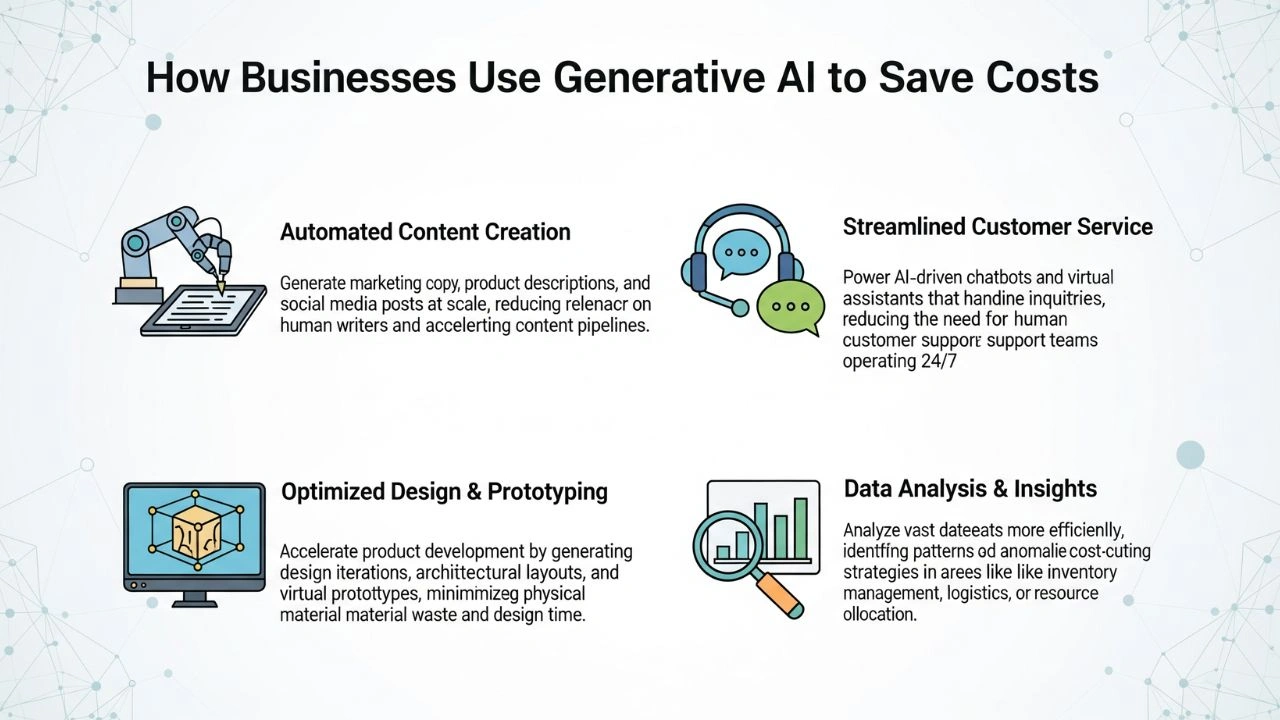
How Businesses Use Generative AI to Save Costs: In today’s highly competitive and economically uncertain environment, businesses are under constant pressure to reduce expenses while maintaining productivity, quality, and customer satisfaction. Generative Artificial Intelligence (AI) has emerged as one of the most powerful tools enabling organizations to achieve this balance. Unlike traditional automation technologies, generative AI can create content, analyze complex data, simulate decisions, and adapt to changing conditions—making it a strategic cost-saving engine rather than just an operational tool.
Across industries, companies are leveraging generative AI to streamline workflows, minimize human error, optimize resource allocation, and unlock new efficiencies. This article explores in depth how businesses use generative AI to save costs, examining real-world applications, operational benefits, challenges, and the long-term financial impact of AI-driven transformation.
Understanding Generative AI and Its Cost-Saving Potential
Generative AI refers to advanced machine learning models capable of producing original outputs such as text, images, code, audio, and predictive insights. These systems learn from massive datasets and can replicate human-like reasoning, creativity, and problem-solving at scale.
The cost-saving power of generative AI comes from its ability to replace or augment high-cost, time-consuming human activities with fast, consistent, and scalable solutions. Instead of hiring additional staff, outsourcing tasks, or investing heavily in manual processes, organizations can deploy AI models that work continuously with minimal marginal cost.
What makes generative AI especially attractive is that it does not merely automate repetitive tasks. It also enhances complex processes such as strategic analysis, forecasting, customer engagement, and innovation—areas traditionally considered expensive and resource-intensive.
Read Also: ChatGPT Review 2025: Features, Pricing, Pros & Cons – Is It Worth Using?
Reducing Labor Costs Through Intelligent Automation
Labor expenses represent one of the largest cost categories for most organizations. Generative AI helps businesses reduce these costs without compromising performance by automating tasks that previously required human intervention.
Customer support is a prime example. AI-powered chatbots and virtual assistants can handle a large percentage of customer inquiries, including order tracking, account updates, troubleshooting, and FAQs. This reduces the need for large customer service teams while maintaining 24/7 availability and consistent service quality.
In back-office operations, generative AI automates tasks such as data entry, document processing, report generation, and compliance checks. By eliminating repetitive manual work, businesses reduce staffing requirements and reallocate human talent to higher-value roles, such as strategic planning and innovation.
Streamlining Content Creation and Marketing Expenses
Marketing and content creation are traditionally expensive, requiring teams of writers, designers, and strategists. Generative AI dramatically lowers these costs by automating content production at scale.
Businesses use AI tools to generate blog articles, social media posts, email campaigns, product descriptions, and advertising copy within minutes. This significantly reduces the need for external agencies or large in-house creative teams. AI can also create multiple content variations, enabling rapid testing and optimization without additional cost.
Beyond text, generative AI produces images, videos, and design assets, further cutting creative production expenses. The result is faster campaign execution, lower marketing spend, and improved return on investment, all while maintaining brand consistency.
Optimizing Software Development and IT Costs
Software development is another area where generative AI delivers substantial cost savings. AI-powered coding assistants help developers write, test, and debug code more efficiently. These tools can suggest functions, identify errors, and even generate entire modules based on simple prompts.
By accelerating development cycles, businesses reduce labor hours and project timelines. This means fewer resources are required to deliver digital products and updates. Additionally, generative AI improves code quality, reducing long-term maintenance and technical debt costs.
In IT operations, AI-driven automation handles system monitoring, incident response, and predictive maintenance. By identifying potential issues before they escalate, businesses avoid costly downtime and emergency fixes, leading to more predictable and lower IT expenses.
Improving Decision-Making to Avoid Costly Mistakes
Poor decisions can be extremely expensive for businesses. Generative AI supports better decision-making by analyzing vast amounts of data, identifying patterns, and simulating outcomes.
Organizations use AI to forecast demand, optimize pricing strategies, and model financial scenarios. This reduces overproduction, excess inventory, and missed revenue opportunities. In industries such as manufacturing and retail, even small improvements in forecasting accuracy can result in significant cost reductions.
Generative AI also supports risk management by detecting anomalies, fraud, and compliance issues early. By preventing costly errors and regulatory penalties, AI protects businesses from financial losses that are often invisible until it is too late.
Enhancing Customer Experience While Lowering Support Costs
Delivering excellent customer experience often requires significant investment. Generative AI allows businesses to improve service quality while simultaneously reducing costs.
AI-driven personalization engines tailor recommendations, messages, and offers based on customer behavior and preferences. This increases conversion rates and customer lifetime value without additional marketing spend.
Virtual assistants and AI-powered self-service platforms empower customers to solve problems independently. This reduces call volumes, shortens resolution times, and lowers support costs. At the same time, customers benefit from faster and more consistent service, improving satisfaction and retention.
Reducing Training and Onboarding Expenses
Employee training and onboarding are costly, especially for large or fast-growing organizations. Generative AI helps reduce these expenses by automating knowledge sharing and learning experiences.
AI-powered training systems generate personalized learning paths, create training materials, and answer employee questions in real time. New hires can access AI assistants that provide instant guidance, reducing reliance on trainers and mentors.
By shortening onboarding time and improving knowledge retention, businesses lower training costs while accelerating employee productivity. This is particularly valuable in industries with high turnover rates.
Optimizing Supply Chain and Operations
Supply chain inefficiencies are a major source of hidden costs. Generative AI enables smarter planning and optimization across procurement, logistics, and inventory management.
AI models analyze historical data, market trends, and external factors to predict demand more accurately. This reduces excess inventory, storage costs, and waste. In logistics, generative AI optimizes routes and schedules, lowering transportation and fuel expenses.
Manufacturers use AI to simulate production scenarios and optimize resource allocation. By improving operational efficiency, businesses achieve significant cost savings without sacrificing quality or delivery speed.
Automating Financial Operations and Compliance
Finance and accounting functions involve complex, detail-oriented tasks that are both time-consuming and expensive. Generative AI automates activities such as invoice processing, expense categorization, financial reporting, and audit preparation.
By reducing manual intervention, businesses lower labor costs and minimize errors that can lead to financial discrepancies or compliance issues. AI-driven compliance monitoring ensures adherence to regulations, reducing the risk of fines and legal costs.
In strategic finance, AI supports budgeting, forecasting, and scenario analysis. This enables organizations to allocate resources more effectively and identify cost-saving opportunities proactively.
Enabling Scalability Without Proportional Cost Increases
One of the most powerful cost-saving advantages of generative AI is scalability. Traditional growth often requires proportional increases in staff, infrastructure, and overhead. Generative AI breaks this pattern.
AI systems can handle increased workloads without linear cost growth. For example, an AI chatbot can manage ten customer inquiries or ten thousand with minimal additional expense. Similarly, AI-driven content engines and analytics platforms scale effortlessly as demand increases.
This allows businesses to grow revenue while keeping costs under control, improving profit margins and long-term financial sustainability.
Lowering Research and Innovation Costs
Research and development are critical for innovation but often come with high costs and uncertain outcomes. Generative AI accelerates research by analyzing existing knowledge, generating hypotheses, and simulating experiments.
Businesses use AI to explore new product designs, optimize materials, and test concepts virtually before committing physical resources. This reduces trial-and-error costs and speeds up time to market.
In industries such as pharmaceuticals, engineering, and technology, generative AI has the potential to save millions in R&D expenses while increasing innovation success rates.
Addressing Challenges and Ensuring Responsible Cost Savings
While generative AI offers significant cost-saving benefits, businesses must approach adoption strategically. Poor implementation can lead to data security risks, biased outputs, or inefficient workflows.
To maximize ROI, organizations need clear objectives, high-quality data, and strong governance frameworks. Employee training is also essential to ensure teams understand how to collaborate effectively with AI systems.
Responsible AI use ensures that cost savings are sustainable and aligned with ethical standards, regulatory requirements, and long-term business goals.
Read Also: Jasper AI Review 2025: Features, Pricing, Pros & Cons – Is Jasper Worth It?
The Long-Term Financial Impact of Generative AI
The cost-saving potential of generative AI extends far beyond short-term efficiency gains. Over time, AI-driven businesses develop more agile, resilient, and data-driven operating models.
By continuously learning and improving, generative AI systems unlock ongoing optimization opportunities. This creates a compounding effect, where cost reductions and productivity gains increase year after year.
Organizations that integrate generative AI strategically are not just cutting expenses—they are building smarter, leaner, and more competitive businesses prepared for the future.
Conclusion – How Businesses Use Generative AI to Save Costs
Generative AI is redefining how businesses think about cost management. From labor and marketing to software development, customer service, and supply chain operations, AI-driven automation delivers measurable financial benefits across the enterprise.
By reducing manual workloads, improving decision-making, and enabling scalable growth, generative AI helps organizations achieve sustainable cost savings without sacrificing quality or innovation. As the technology continues to evolve, businesses that embrace generative AI today will be best positioned to thrive in an increasingly competitive global economy.
Generative AI is not merely a tool for efficiency—it is a strategic asset for long-term cost optimization and business success.