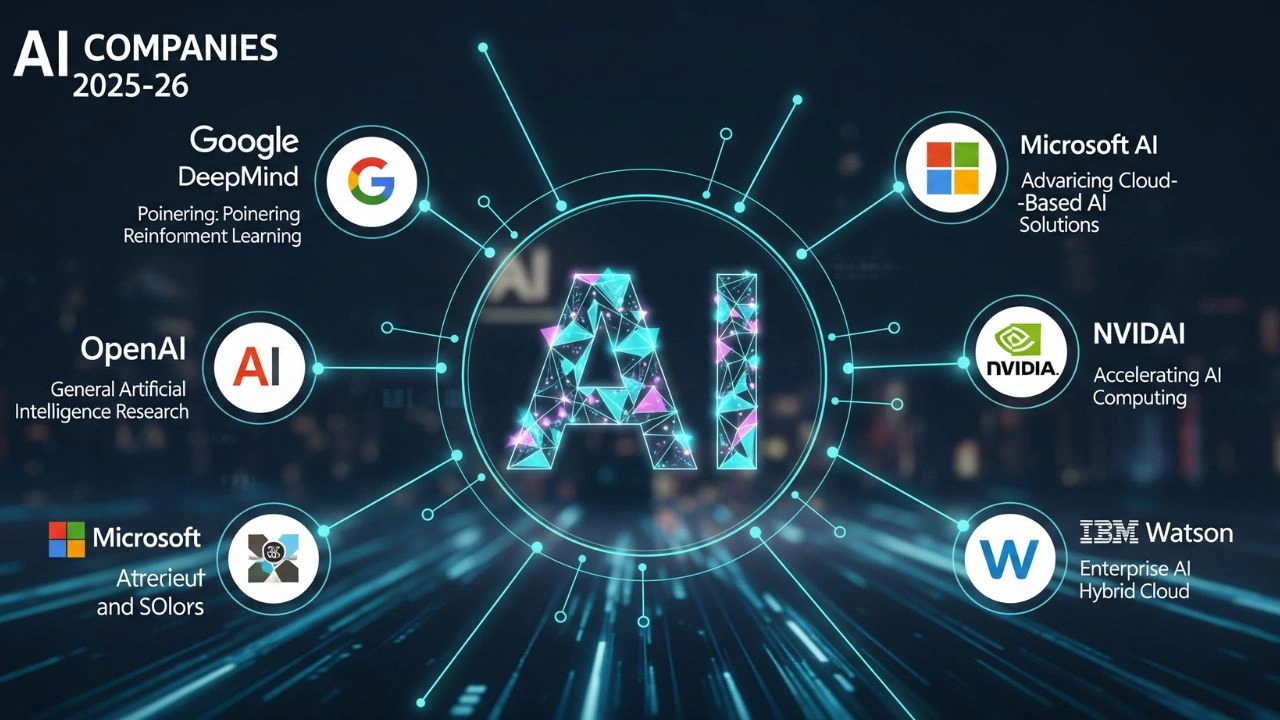
Leading AI Companies in 2025-26: Artificial Intelligence (AI) is reshaping industries, accelerating innovation, and redefining what’s possible in technology, healthcare, energy, education, and more. But while the idea of AI has been around for decades, the global AI race — where companies compete to build the most advanced, useful, and scalable AI systems — is now in full throttle.
Today, certain organizations are leading this race, not just by creating powerful AI models, but by integrating them into products people use daily and by building ecosystems that others depend upon. In this comprehensive guide, we’ll explore the leading AI companies in 2025-26, what they’re known for, how they compete, and what real value they bring to businesses and consumers.
1. OpenAI: Powering the Future of Generative AI
The Company That Put AI in Everyone’s Hands
OpenAI is widely recognized as one of the most impactful AI organizations of the decade. Its mission is to ensure that artificial general intelligence (AGI) benefits all of humanity — a goal that has shaped its research priorities, product releases, and partnerships.
Key Contributions
- GPT Series: OpenAI’s Generative Pretrained Transformers (GPT) have set industry benchmarks for natural language understanding and generation. These models power a wide range of applications — from content creation and programming assistance to customer support and education.
- ChatGPT Ecosystem: ChatGPT became a household name, demonstrating how AI could interact conversationally with users. Its ability to write, explain, and ideate has dramatically increased the visibility of AI.
- DALL-E and Image Models: Beyond text, OpenAI’s AI systems can generate high-quality images and visual content, broadening the scope of creative applications.
Strategic Partnerships
OpenAI’s collaboration with Microsoft — particularly around cloud services (Azure AI) — has been transformative. These partnerships have helped scale compute resources for training massive models and integrate OpenAI’s tech into enterprise tools like Microsoft 365 Copilot.
What Sets OpenAI Apart
- Focus on large foundational models that generalize across tasks
- Strong ecosystem with APIs and developer tools
- High public visibility and adoption
- Balanced approach to safety, research, and commercial products
2. Google DeepMind & Google AI: The Research Powerhouse
A Leader in Fundamental AI Research
Google is not just a search engine; it’s one of the biggest players in AI. Within Google, DeepMind and Google AI lead different but complementary missions:
- DeepMind focuses on foundational research, cognitive modeling, and breakthroughs in deep learning and reinforcement learning. It’s the team behind AlphaGo, AlphaFold (a revolutionary protein-folding AI), and other scientific advances.
- Google AI builds practical AI technologies embedded into Google’s vast product ecosystem — including Search, Assistant, Translate, and Android.
Pioneering Technologies
- Transformer Architecture: Originally introduced by researchers at Google, transformers are now the backbone of modern NLP and generative models — including those from competitors like OpenAI.
- AI in Search & Productivity: Google integrates AI everywhere you see it — from search result improvements and language translation to predictive typing and intelligent recommendations.
Strategic Strengths
- Tremendous access to data from billions of users worldwide
- World-class research labs with deep scientific expertise
- Integration across consumer and enterprise products at scale
- Strong partnerships with academic institutions
Google’s AI ecosystem is powerful because it spans both research breakthroughs and real-world product delivery.
Read Also: Best Generative AI Tools for Business Automation in 2025
3. Microsoft: Enterprise-Ready AI at Scale
AI for Business and Productivity
Microsoft is a top contender in the AI race because of its ability to integrate AI into enterprise workflows — turning cutting-edge research into tools that businesses actually use.
Major AI Initiatives
- Azure AI Platform: A suite of tools and APIs that help businesses build, train, deploy, and manage AI models.
- Copilot in Microsoft 365: AI assistants embedded into Word, Excel, Outlook, and Teams that help users write, summarize, analyze data, and automate tasks.
- Partnership with OpenAI: Microsoft’s strategic investment and cloud collaboration have positioned Azure as a go-to platform for large-scale AI training and deployment.
Why Microsoft Matters
- Trusted by enterprises globally
- Deep integration of AI into widely used business software
- Massive cloud infrastructure to support AI workloads
- Growing set of development and management tools for AI
Microsoft’s strength is not just in building models — it’s in helping companies use AI reliably and securely at enterprise scale.
4. NVIDIA: The Hardware Power Behind AI
Not a Model Maker — But AI Enabler
If companies like OpenAI and Google are building AI models, NVIDIA provides the power that makes those models possible.
AI systems require vast amounts of computational power, and NVIDIA’s GPUs (graphics processing units) have become the standard hardware for training and running advanced machine learning models.
Core Contributions
- GPU Accelerators: NVIDIA’s GPUs dramatically speed up the training of deep learning models.
- AI Software Stack: Tools like CUDA, cuDNN, and NVIDIA AI Enterprise simplify the development and deployment of AI.
- Data Center Solutions: NVIDIA’s hardware serves cloud providers, research centers, and enterprise AI developers globally.
Impact on the AI Race
Without NVIDIA’s hardware, scaling large AI models would be slow and prohibitively expensive. This makes the company essential in the AI ecosystem, even if it doesn’t release generative AI models itself.
5. Meta (Facebook): AI at Social Scale
Training AI on Billions of Social Interactions
Meta (formerly Facebook) uses AI across its platforms — Facebook, Instagram, WhatsApp, and Oculus — to improve recommendations, moderation, ads, and user experience.
Key AI Projects
- Large Language Models: Meta AI has developed open models like LLaMA that compete with proprietary rivals.
- Content Understanding and Personalization: AI systems that curate feeds, filter content, and recommend connections are central to the user experience.
- Horizon Worlds & the Metaverse: Meta is investing in AI to power virtual environments, voice interfaces, and immersive experiences.
What Meta Excels At
- Building AI that operates at social scale
- Large datasets from billions of users
- Combining AI with VR/AR to imagine future platforms
Meta’s AI influences everyday digital interactions for billions, making it a key leader in the AI landscape.
6. Amazon: AI in Cloud, Retail, and Everyday Life
AI Across Consumer and Enterprise Domains
Amazon is another AI leader that applies artificial intelligence in unique and impactful ways:
- AWS AI Services: Tools for vision, speech, language, recommendation systems, and machine learning services used by startups and global enterprises.
- Alexa: One of the most widely used conversational AI assistants in the world.
- Logistics and Retail: Amazon uses AI for inventory optimization, price recommendations, supply chain forecasting, and delivery routing.
Why Amazon’s AI Matters
- Massive cloud ecosystem (AWS) drives AI innovation for others
- Real-world usage through consumer products and services
- Strong research in speech, robotics, and automation
Amazon’s AI strategy is broad and practical, touching businesses and consumers simultaneously.
7. IBM: Enterprise AI With a Focus on Trust
AI for Business, Not Buzz
IBM has been involved in AI for decades, and its approach emphasizes enterprise readiness, trust, and explainability.
Key Platforms
- Watson AI: A suite of tools for data analysis, language understanding, and automation geared toward enterprise use.
- AI Governance: Tools to help businesses understand, monitor, and control AI decision-making.
IBM’s focus is less on flashy generative models and more on trusted, responsible AI in regulated industries like finance, healthcare, and government.
8. Apple: AI Behind the Scenes
AI Embedded in Everyday Devices
Apple may not compete publicly with giant open models, but it uses AI extensively across its products:
- Siri and Natural Language Understanding
- On-device intelligence for photo recognition, predictive typing, and personalization
- Privacy-preserving AI that processes data locally when possible
Apple’s AI strategy focuses on user experience, device efficiency, and data privacy — a contrast to cloud-centric approaches from others.
9. Baidu, Tencent & Alibaba: The Chinese AI Giants
AI Leaders in Asia and Beyond
In China’s rapidly evolving tech ecosystem, several companies are pushing AI development on multiple fronts:
- Baidu: Known for autonomous driving platforms, language models, and AI research.
- Tencent: AI in gaming, social platforms, healthcare, and cloud services.
- Alibaba: AI applied to e-commerce personalization, logistics prediction, and cloud AI tools.
These companies not only lead in China but increasingly collaborate globally and compete in AI research and product development.
10. Emerging AI Innovators & Specialized Players
Beyond the biggest names, several companies are innovating in AI niches:
- Anthropic: Safety-focused AI research and language models
- Cohere and AI21 Labs: Large language model developers with unique positioning
- Stability AI: Open-source image and generative model leadership
- Hugging Face: A major hub for open AI models and developer collaboration
These companies influence the AI ecosystem by pushing openness, safety, and specialization.
What Does It Mean to “Lead” in AI?
Multiple Dimensions of Leadership
Being a leader in AI today does not mean just building the biggest model. Leadership manifests in several ways:
- Research Breakthroughs: Advancing fundamental understanding of intelligence and learning
- Scalable Products: AI that millions (or billions) use reliably
- Business Adoption: Tools that help companies innovate and compete
- Ethics and Trust: Responsible development and deployment
- Ecosystem Support: Tools, platforms, and partnerships that empower others
Each company above leads in different combinations of these dimensions.
Real Problems AI Is Solving Today
Understanding who leads AI is important, but the real value comes from how AI solves real human problems:
- Healthcare: Faster diagnosis, personalized treatment planning, discovery of new medicines
- Climate Tech: Modeling environmental outcomes and optimizing energy usage
- Education: Personalized learning pathways and tutoring support
- Business Efficiency: Automated workflows and predictive analytics
- Creativity & Productivity: Tools that help writers, designers, and engineers
AI is not just a technological arms race — it’s a force reshaping how we live and work.
Challenges & Ethical Considerations
Leadership in AI also means addressing risks:
- Bias and fairness
- Data privacy
- Job displacement concerns
- Safety and misuse prevention
- Regulation and governance
Companies investing in responsible AI practices are positioning themselves not just as innovators, but as trusted leaders.
Read Also: GitHub Copilot vs DeepSeek: Best AI Code Assistance Tools for Developers in 2026
The Future of the AI Race
AI in 2026 and beyond will likely be defined by:
- Foundation models that generalize across domains
- Multi-modal intelligence combining text, vision, audio, and video
- On-device AI that respects privacy and reduces dependence on cloud
- AI safety frameworks adopted globally
- Collaborative ecosystems between industry, government, and academia
The fastest movers today may not automatically lead tomorrow — adaptability, ethical responsibility, and real-world impact will shape future winners.
Conclusion: Who’s Winning the AI Race?
There’s no single answer — because winning AI means leadership across research, products, real-world adoption, responsibility, and future readiness. The companies discussed here represent the most influential players shaping AI today:
- OpenAI — Generative AI pioneers
- Google DeepMind & Google AI — Research and scale
- Microsoft — Enterprise AI at scale
- NVIDIA — Hardware and infrastructure enabler
- Meta — Social and foundational models
- Amazon — AI in cloud and consumer applications
- IBM — Trusted enterprise AI
- Apple — Device-centric AI experiences
- Chinese giants — Massive scale and regional leadership
- Emerging innovators — Safety, openness, niche leadership
Together, these companies are pushing AI forward — not as a single sprint, but as a multi-front global race with real impact on society, the economy, and daily life.
4 thoughts on “Leading AI Companies in 2025-26: Who’s Winning the Global AI Race?”