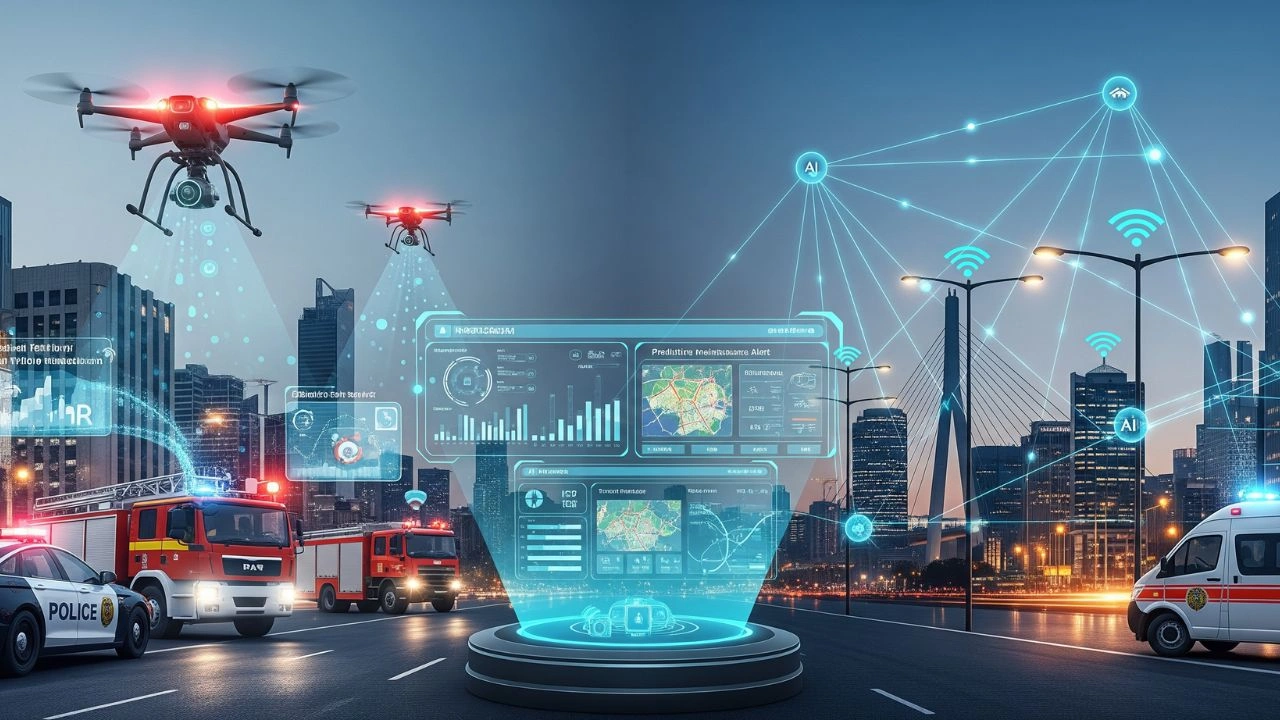
AI in Public Safety and Infrastructure: Artificial intelligence is redefining how governments protect citizens, manage infrastructure, and make critical decisions under pressure.
Public safety and infrastructure form the foundation of modern civilization. From emergency response systems and transportation networks to energy grids and water supplies, these complex systems must operate reliably in an increasingly unpredictable world. Climate change, rapid urbanization, cyber threats, and geopolitical uncertainty have placed extraordinary pressure on public sector institutions to deliver safety, resilience, and efficiency at scale.
In this environment, artificial intelligence (AI) has emerged as one of the most powerful tools available to governments and public agencies. Rather than replacing human decision-makers, AI enhances their ability to interpret vast amounts of data, anticipate risks, and act decisively. The experiences and methodologies developed by companies such as BigBear.ai provide valuable lessons on how AI can be responsibly and effectively deployed in public safety and infrastructure domains.
AI as the New Intelligence Layer for Public Safety
Public safety agencies have traditionally relied on historical data, manual reporting, and human intuition to make decisions. While effective in the past, these approaches struggle to keep pace with the volume and velocity of modern data. AI introduces an intelligence layer that continuously analyzes information from multiple sources in real time.
This includes surveillance systems, emergency call centers, traffic sensors, weather feeds, social media signals, and legacy databases. AI-powered platforms can detect correlations, anomalies, and emerging threats far faster than manual processes. The result is a shift from reactive response to proactive prevention, enabling agencies to intervene before situations escalate.
BigBear.ai’s work highlights the importance of decision intelligence—AI systems designed not just to analyze data, but to support complex operational decisions. This distinction is critical in public safety, where context, consequences, and accountability matter as much as accuracy.
Read Also: AI Video Automation Tools for Social Media Posting 2026 Guide
Enhancing Situational Awareness Through Data Fusion
One of the greatest challenges in public safety operations is fragmented information. Data often exists in silos across departments, jurisdictions, and technologies. AI excels at data fusion, bringing together disparate datasets into a unified operational picture.
By integrating structured data (such as crime statistics or infrastructure logs) with unstructured data (such as video feeds or text reports), AI systems create comprehensive situational awareness dashboards. These dashboards help commanders and policymakers understand what is happening, why it is happening, and what actions are most likely to succeed.
Lessons from BigBear.ai emphasize that situational awareness must be actionable. Visualization, prioritization, and explainability are essential so that decision-makers can trust and act on AI-generated insights during time-critical situations.
Predictive Analytics and Risk Anticipation
Perhaps the most transformative capability of AI in public safety is predictive analytics. Instead of responding after incidents occur, AI models forecast where and when risks are most likely to emerge.
For example, predictive models can identify high-risk traffic intersections, forecast emergency service demand during extreme weather events, or anticipate crime patterns based on historical and environmental factors. This foresight enables smarter resource allocation, reducing response times and improving outcomes.
BigBear.ai’s approach demonstrates that predictive systems must be continuously updated and validated. Public safety environments are dynamic, and models must adapt to changing behaviors, policies, and external conditions to remain effective and unbiased.
Securing and Optimizing Critical Infrastructure
Critical infrastructure systems—such as power plants, transportation networks, ports, and water treatment facilities—are increasingly complex and interconnected. A failure in one system can cascade across others, causing widespread disruption.
AI-powered monitoring tools analyze sensor data, operational logs, and external threat intelligence to detect anomalies early. Predictive maintenance algorithms identify signs of wear, stress, or cyber intrusion before failures occur, allowing operators to intervene proactively.
Insights from BigBear.ai show that infrastructure AI must be mission-aware. Models should understand operational priorities, safety thresholds, and regulatory constraints. This ensures that AI recommendations align with real-world objectives rather than theoretical optimizations.
AI in Disaster Preparedness and Crisis Response
Natural disasters and large-scale emergencies test the limits of public safety and infrastructure systems. AI plays a critical role in disaster preparedness, simulation, and response coordination.
By analyzing historical disaster data, climate projections, and geographic information, AI systems can simulate disaster scenarios and assess potential impacts. These simulations help governments plan evacuation routes, pre-position resources, and design resilient infrastructure.
During active crises, AI supports real-time decision-making by tracking evolving conditions, coordinating multi-agency responses, and identifying bottlenecks. BigBear.ai’s experience highlights the necessity of explainable AI in crisis contexts, where leaders must understand the rationale behind recommendations to make confident decisions.
Cybersecurity and Infrastructure Protection
As infrastructure becomes more digitized, cyber threats pose a growing risk to public safety. AI-driven cybersecurity tools monitor network activity, detect unusual patterns, and respond to threats faster than traditional systems.
AI enhances threat detection by learning normal system behavior and flagging deviations that may indicate attacks or system failures. This proactive defense capability is essential for protecting critical assets from increasingly sophisticated adversaries.
Lessons from BigBear.ai underscore the importance of integrating cybersecurity intelligence with physical security and operational data, creating a holistic defense strategy that reflects modern threat landscapes.
Ethical AI and Public Trust
Deploying AI in public safety carries significant ethical responsibilities. Decisions influenced by AI can affect civil liberties, privacy, and public confidence. Trust is the cornerstone of successful public sector AI adoption.
Ethical AI frameworks must address data governance, bias mitigation, transparency, and accountability. Systems should be auditable, explainable, and aligned with legal and societal norms. BigBear.ai’s emphasis on governance-first AI design illustrates how responsible practices build long-term trust among stakeholders.
Public communication is equally important. When citizens understand how AI is used and how their data is protected, acceptance and cooperation increase.
Human-AI Collaboration in High-Stakes Environments
Contrary to popular fears, AI does not replace public safety professionals—it empowers them. AI handles data-intensive analysis, freeing humans to focus on judgment, leadership, and ethical considerations.
Effective human-AI collaboration requires training, clear workflows, and cultural adaptation. Agencies that invest in workforce readiness see higher adoption rates and better outcomes. AI succeeds when it complements human expertise rather than competing with it.
BigBear.ai’s work reinforces the idea that humans remain accountable decision-makers, with AI serving as a trusted advisor.
Read Also: GitHub Copilot vs DeepSeek: Best AI Code Assistance Tools for Developers in 2026
Scalability and Interoperability Across Agencies
Public safety and infrastructure challenges often span jurisdictions and agencies. AI platforms must therefore be scalable and interoperable, supporting collaboration across local, regional, and national levels.
Cloud-native architectures, standardized data interfaces, and modular AI services enable systems to evolve as needs change. Lessons from BigBear.ai show that flexibility and adaptability are critical for long-term success in complex public sector environments.
The Long-Term Vision for AI in Public Safety
Looking ahead, AI will become deeply embedded in public safety and infrastructure operations. From smart cities and autonomous transportation to climate resilience planning, AI will transition from innovation to necessity.
The key takeaway from BigBear.ai’s experience is that technology alone is not enough. Success depends on aligning AI capabilities with mission objectives, ethical principles, and human expertise.
Governments that adopt AI thoughtfully—learning from proven models and prioritizing trust—will be better equipped to protect citizens, safeguard infrastructure, and navigate an increasingly uncertain future.
2 thoughts on “The Future of AI in Public Safety and Infrastructure”